
Top Reasons Why Your Website Isn’t Ranking on Google (And How to Fix It in 2026)


Why 97% of Websites Get Zero Traffic
Table of Contents
Serious about growing your business? Let’s plan exactly how to get you more leads, sales, and results—faster.
You invested in a website.
You’re publishing content.
You may have even hired someone for SEO.
So why does your business still barely show up on Google?
We see this every week.
According to WordStream’s latest 2026 report, over 97% of web pages get zero organic traffic from Google.
And most websites fail to rank because the fundamentals were never done right.
And it usually comes down to a few simple problems:
- Google can’t access pages correctly.
- The site targets the wrong searches.
- Content doesn’t fully answer what people are looking for.
- Trust and authority are thin.
When that happens, nothing else sticks.
We’ve audited hundreds of underperforming websites across different industries, and the pattern is almost always the same: small foundational issues quietly killing visibility.
In this article, we’ll walk you through the real reasons websites fail to rank in 2026, and exactly what you can do to fix each one.
Let’s start with the simplest issue that blocks everything else:
Your website isn’t indexed by Google.
Your Website Is Not Indexed by Google
If Google hasn’t indexed your site, it cannot rank.
Indexing means Google has discovered and stored your pages. If a page is not indexed, it will not appear in search results, no matter how good the content is.
Start by checking whether Google can see your pages.
Search on Google:
site: yourdomain.com
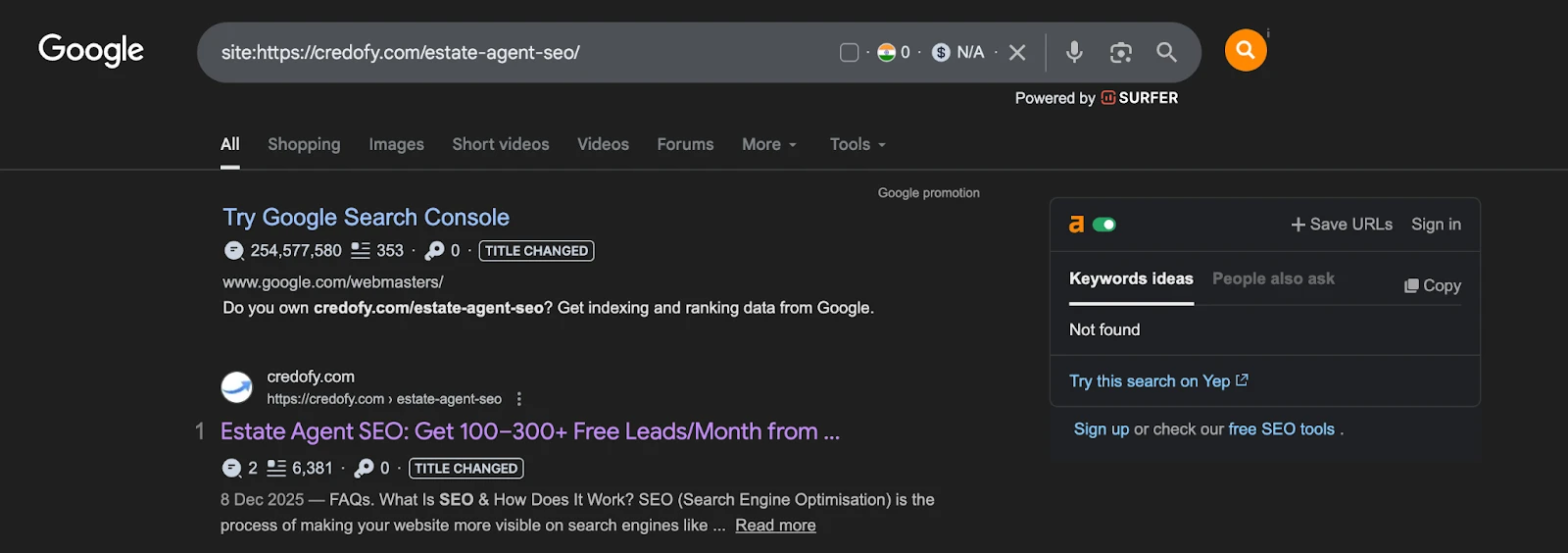
If you see very few results, or none, you likely have an indexing problem.
You can also check individual URLs in Google Search Console using the URL Inspection tool to see whether a page is indexed and why.
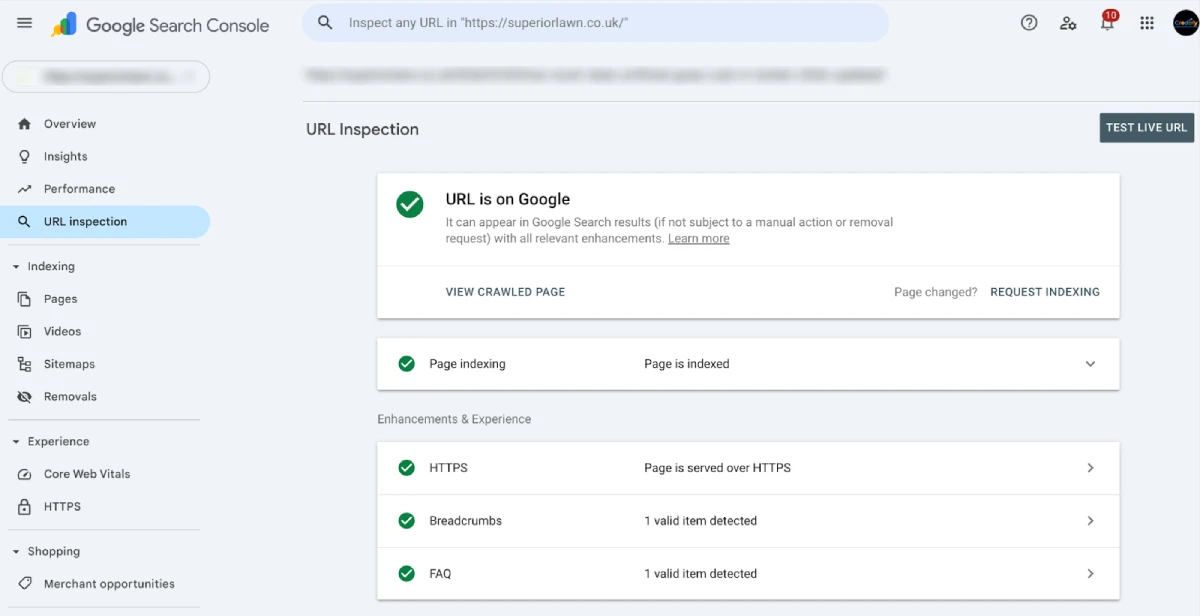
Common signs of indexing issues include:
- New pages taking weeks to appear
- Blog posts never showing up
- Pages marked as “Discovered – currently not indexed"
- Little or no impression data in Search Console
Most indexing problems are caused by a small set of issues: no XML sitemap, pages blocked by robots.txt, noindex tags, weak internal linking, or poor site structure.
The fixes are simple:
- Set up Google Search Console.
- Submit an XML sitemap.
- Request indexing for key pages.
- Remove noindex tags.
- Check robots.txt.
- Internally link every important page.
Indexing alone will not guarantee rankings.
But without indexing, nothing else matters.
Recommended Read: The Future of SEO Marketing (2026 Edition): Best Practices, Tools, and Costs Explained
Marketing Research & Strategy
We help you understand your market and build smart strategies to attract more customers and grow faster.
- Detailed research into your competitors, customers, and market
- Custom marketing and growth plans that drive real results
- Clear action steps to increase traffic, leads, and sales


ADWORDS ROI

Cut Ad spend

You’re Targeting Keywords Nobody Searches For
Google ranks pages that solve real search problems.
If your website targets vague phrases like:
- “Welcome to our company”
- “Best services in the city”
- “Trusted experts”
You are not giving Google or users anything specific to work with.
These phrases sound professional, but they are not how people actually search.
When users want to buy or take action, they type clear, intent-driven queries such as:
- Best [service] in [city]
- Cost of [service] in [city]
- [Service] near me
- How to choose a [service provider]
These searches show intent.
Intent is what Google rewards.
If nobody searches for a phrase, Google has no reason to rank a page for it.
The fix is simple.
Use keyword research tools like Semrush, Ahrefs or Google Keyword Planner to find real search terms.
Choose keywords with buying or problem-solving intent. Create one main page per primary keyword. Do not try to rank one page for multiple unrelated topics.
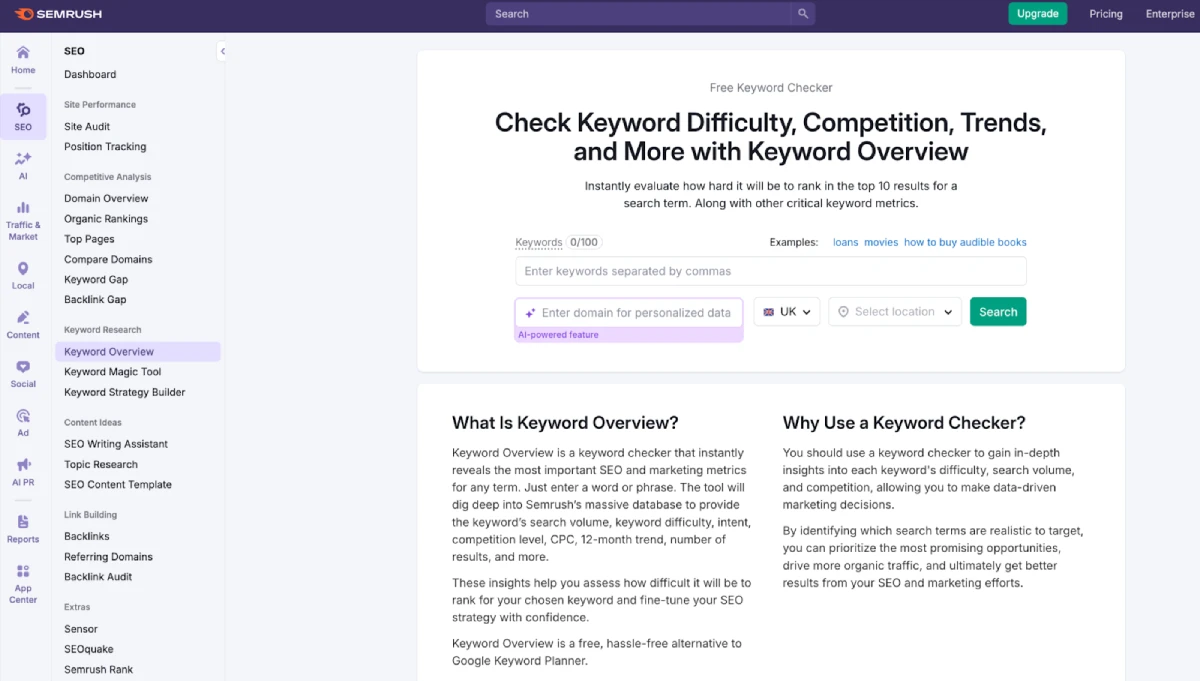
Source: Semrush
When your keywords match what people actually type into Google, rankings become possible.
Related Read: Estate Agent SEO 2026: How Top UK Agencies Get 50–300+ Free Google Leads Every Month
Your Content Isn’t Good Enough to Rank
If your content looks like everyone else’s, Google has no reason to rank it.
Google’s systems are designed to prioritise helpful, reliable, people-first content, not thin pages written mainly to satisfy search engines.
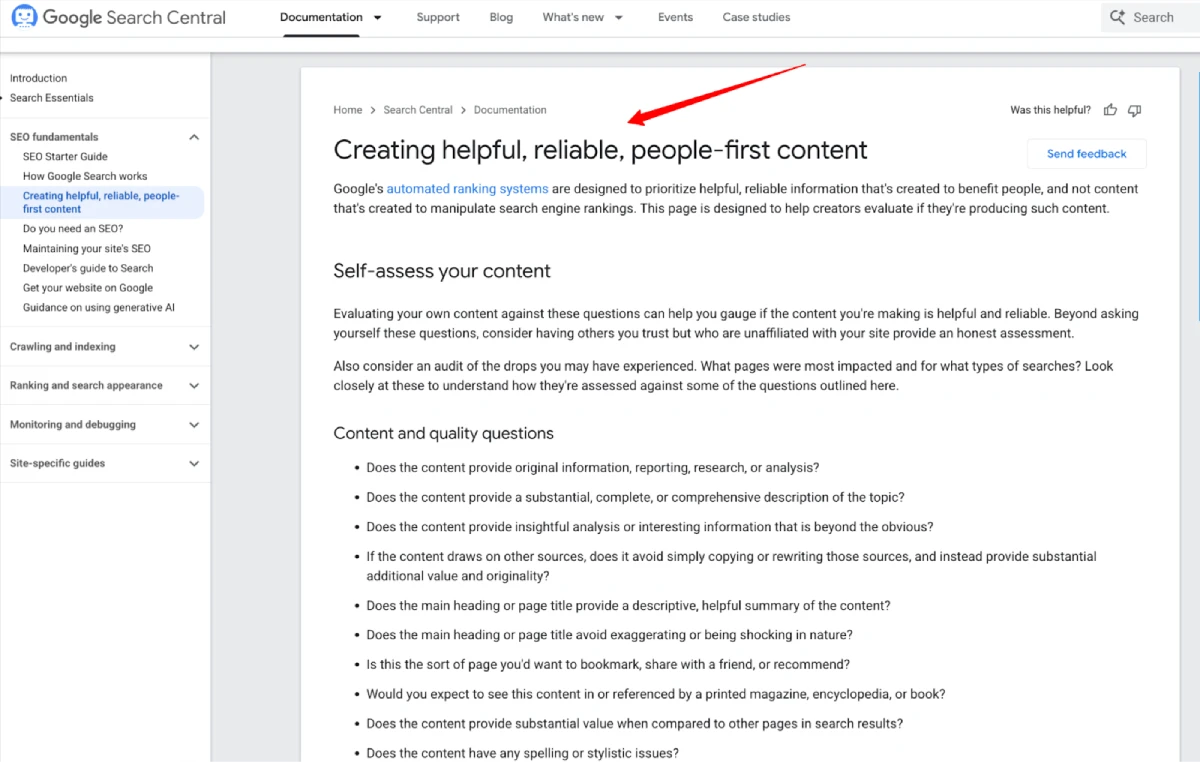
Source: Google Developers
They consistently reward pages that demonstrate depth, originality, and real usefulness.
Large-scale SEO research has shown that content quality is one of the strongest factors influencing organic rankings and traffic, alongside keyword relevance and backlinks.
In practical terms, Google tends to filter out content that simply repeats advice already found on thousands of other websites.
Pages that lack real examples, proof, or clear guidance rarely perform well. Content that feels written only for SEO, rather than for humans, also struggles to gain traction.
To improve your chances of ranking, shift your focus from word count to usefulness.
Digital Marketing, SEO & PPC
- SEO to boost rankings and capture high-intent, AI-driven traffic
- Performance Marketing to run ROI-focused campaigns that convert
- Content Marketing to drive clicks, earn links, and build authority

For every important page, add something concrete and practical.
That might mean relevant data or statistics, real-world examples, step-by-step instructions, or insights drawn from your own experience.
Visuals, tables, and diagrams can also make complex ideas easier to understand.
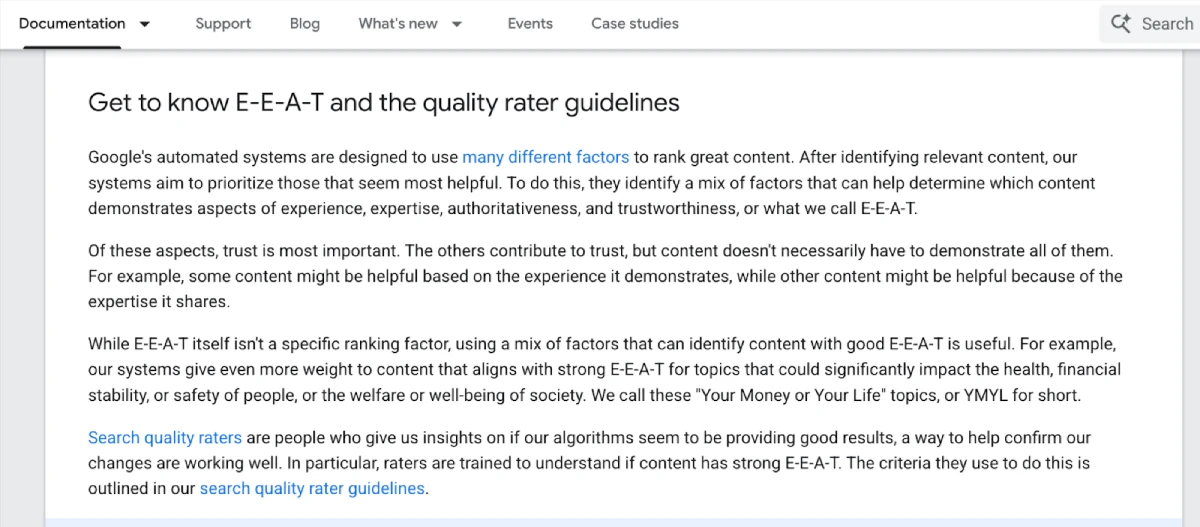
Here’s the thing. Google doesn’t just look at what you say. It looks at whether you seem trustworthy.
This is where E-E-A-T comes in: Experience, Expertise, Authoritativeness, and Trust. Pages that show first-hand knowledge, credible information, and clear proof that you know your subject tend to rank higher.
Source: Google Developers
Case studies, results, author bios, testimonials, and cited sources all help reinforce this.
Good content does more than include keywords.
It answers the user’s question fully, clearly, and in a way they can actually act on.
When your content truly satisfies what the searcher is looking for, Google is far more likely to reward it with visibility.
Technical SEO Problems Are Holding You Back
Even great content will not rank on a broken website.
If your site is slow, difficult to crawl, or frustrating to use, rankings will stall no matter how good your content is.
Google uses page experience, mobile usability, and Core Web Vitals as ranking signals.
They also report that 53% of mobile users leave a page if it takes longer than three seconds to load. Pages that pass Core Web Vitals are far more likely to perform better in search than pages that fail.
Technical SEO does not usually boost rankings on its own.
But when it is broken, it quietly drags everything down.
Common problems include slow page speed, mobile errors, broken links, duplicate meta titles and descriptions, thin pages, and poor site structure.
Any one of these can limit crawling, indexing, and ranking.
Start with the basics:
- Run a technical SEO audit in Google Search Console and PageSpeed Insights.
- Improve Core Web Vitals.
- Compress images.
- Fix duplicates.
- Remove or merge thin pages.
- Ensure your site is fully HTTPS.
You do not need a perfect website.
You need a technically healthy one.
Once technical issues are under control, your content and links can finally work as intended.
Google Doesn’t See You as an Authority
Google does not rank pages in isolation.
It ranks websites that demonstrate depth, relevance, and trust around a topic.
When content is scattered, thin, or unconnected, Google often chooses competitors who show stronger topical coverage.
SEO research consistently shows that top-ranking pages usually sit within a cluster of related content that is tightly interlinked.
For example, if you want to rank for “property investment in the UK,” Google expects your site to also cover topics such as:
- buy-to-let investing,
- student accommodation,
- off-plan property,
- rental yields by city,
- property hotspots,
- market forecasts, and
- mortgage options.
One standalone article will not establish authority.
A connected group of in-depth pages around these subtopics signals to Google that your site genuinely understands the subject.
This matters because Google’s algorithms are increasingly focused on semantic relevance and topic relationships. Sites with strong thematic coverage tend to outrank those with superficial or disconnected pages.
The fix is straightforward.
Create one pillar page around your core topic. Publish 6–10 supporting articles that explore related subtopics. Internally link everything together so Google can clearly see how the pages connect.
When your content tells a coherent, structured story, authority builds.
And when authority builds, rankings follow.
See how we helped this property business rank for more than 5000+ queries on Google and AI search engines.

You’re Invisible in Local Search
Most service-based searches are local.
When someone types:
- “estate agent near me”
- “property management in Manchester”
- “letting agent in Birmingham”
they’re usually ready to take action.
Industry research continues to show that local intent is a major driver of search behaviour.
According to data compiled by BrightLocal and other SEO research bodies, around 46% of all searches on Google have local intent, meaning users are actively looking for nearby businesses, services, or locations.
At the same time, location-based queries — including searches using terms like “near me” or implicit local intent — have grown significantly over the past few years.
So, if your business doesn’t appear in local results, you’re missing some of the highest-intent traffic available.
We see this constantly.
Businesses invest in websites and content, but completely overlook local SEO. As a result, Google has no strong local signals to associate with their brand.
The fix is straightforward:
Source: Google Business
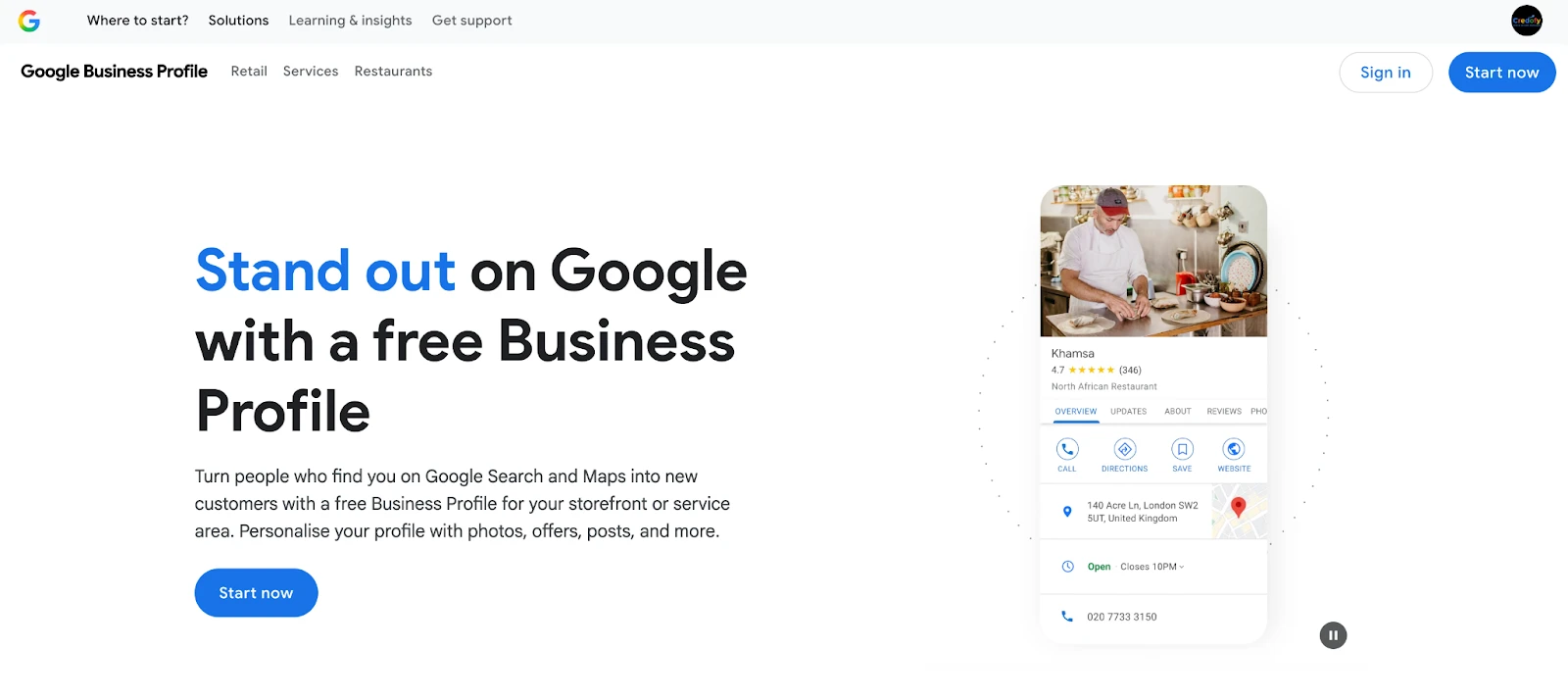
- Fully optimise your Google Business Profile
- Create dedicated city + service pages (for example: Property Investment in Leeds, Estate Agents in Nottingham)
- Collect genuine customer reviews consistently
- Keep your Name, Address, and Phone Number (NAP) identical across your website and directories
- Embed Google Maps on key location pages
Local SEO works faster than broad national SEO because competition is narrower and intent is clearer.
If you want enquiries, not just traffic, local visibility is one of the quickest wins.
You Have Little or No Backlinks
Backlinks are still one of Google’s strongest trust signals.
A backlink is simply another website linking to yours. To Google, that link acts like a vote of confidence.
If reputable sites point to you, Google is more likely to trust your content.
Multiple industry studies continue to show a clear correlation between higher-ranking pages and stronger backlink profiles. In simple terms, pages with quality backlinks tend to outrank pages without them.
This doesn’t mean you need hundreds of links.
It means you need the right links.
Low-quality, spammy links rarely help. In some cases, they can even hurt.
What makes the real difference is relevance and credibility.
Here are reliable ways to build backlinks:
- List your business in legitimate business directories
- Contribute articles to relevant industry blogs
- Publish guest posts on reputable websites
- Earn mentions through digital PR (case studies, data, commentary)
- Build partnerships with complementary businesses
Always prioritise quality over quantity.
One strong link from a trusted, relevant website can be more valuable than fifty weak ones.
Your Website Doesn’t Turn Visitors Into Leads
A lot of websites actually get traffic.
They just do not get enquiries.
When that happens, the usual conclusion is that SEO does not work.
In most cases, SEO did exactly what it was supposed to do. People found your site, clicked through, and landed on your pages. The real issue is what happened after they arrived.
There was no clear reason to take the next step.
SEO’s role is to bring the right people to your website.
Your website’s role is to turn those people into leads.
If your site does not guide visitors toward an action, traffic quietly slips away.
This is what typically fixes the problem:
- Clear calls to action that are easy to see
- Simple offers that give people a reason to engage (guides, calculators, free audits, quotes)
- Short, friction-free forms
- Dedicated landing pages for your core services
Every important page should make the next step obvious.
Related Read: Why You’re Not Getting Enough Quality Real Estate Leads (2025–2026)
Marketing Research & Strategy
We help you understand your market and build smart strategies to attract more customers and grow faster.
- Detailed research into your competitors, customers, and market
- Custom marketing and growth plans that drive real results
- Clear action steps to increase traffic, leads, and sales
ADWORDS ROI
Cut Ad spend
You’re Expecting SEO Results Too Soon
SEO is competitive, and it takes time.
Google does not rank new or improved pages overnight. Before a page can perform, Google needs to discover it, crawl it, index it, and then evaluate how it compares with other pages already ranking for the same search.
That process is gradual.
In most industries, a realistic SEO timeline looks like this:
-
0–3 months:
groundwork such as technical fixes, indexing, and publishing new content -
3–6 months:
early movement, including impressions, ranking shifts, and initial traffic -
6–12 months:
more stable rankings and consistent leads
This does not mean nothing is happening in the early months. It means Google is collecting signals and testing your site.
One of the biggest mistakes we see is businesses stopping too early. They publish a few pages, wait a short time, see limited change, and assume SEO does not work.
SEO works when it is treated as a long-term growth channel.
Staying consistent, tracking performance, and improving pages month after month is what produces results.
SEO compounds.
Small gains build on top of each other, and over time they turn into meaningful visibility and leads.
Also Read: 20 Advanced Lead Generation Strategies to Secure High-Quality Leads in 2025

You Don’t Have a Real SEO System
Most websites do not struggle because SEO is overly complex.
They struggle because there is no organised process behind their efforts.
Content is published without keyword research. Technical issues are addressed only when something breaks. Performance is rarely reviewed in any meaningful way.
That isn’t SEO.
Websites that rank consistently follow a simple, repeatable process.
Every month, they:
- Research keywords people are actually searching for
- Decide which pages to create or improve
- Publish or update content based on search intent
- Check for technical issues that block performance
- Add internal links between related pages
- Review rankings, impressions, and clicks
- Adjust pages based on what the data shows
This is a system.
Not one-off tasks.
Not random blog posts.
When SEO runs as a system, you always know:
What to work on.
Why you’re working on it.
How success is measured.
The fix is not to “do more SEO.” The fix is to build one simple SEO workflow and run it every month.
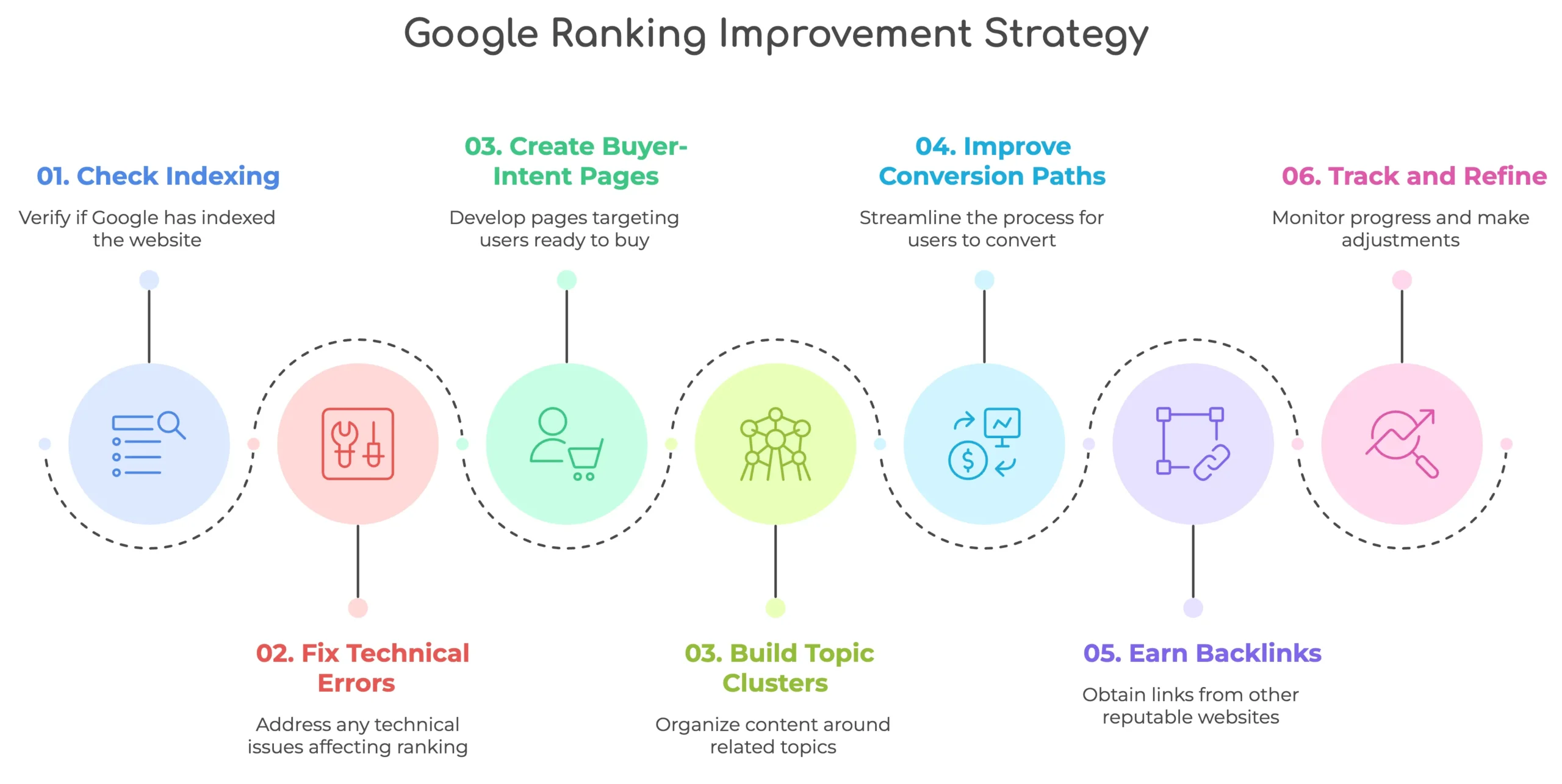
Simple Action Plan to Rank Higher on Google
Start here:
Check indexing
Make sure Google can see your website.
Set up Google Search Console, submit your XML sitemap, and use the URL Inspection tool to confirm that your important pages are indexed. If Google cannot index your pages, nothing else will work.
Fix technical errors
Run a basic technical audit.
Look for slow page speed, mobile usability problems, broken links, duplicate titles, and thin pages. Fix the issues that block crawling, indexing, and usability first.
Create buyer-intent pages
Focus on pages that target people ready to take action.
Examples include:
- Best [service] in [city]
- Cost of [service]
- [Service] for [audience type]
These pages drive leads, not just traffic.
Build topic clusters
Choose one main topic and create a pillar page around it.
Then publish several supporting articles that cover related subtopics and internally link everything together.
This builds topical authority and makes ranking easier over time.
Improve conversion paths
Make sure every important page has a clear next step.
Add visible calls to action, simple forms, and relevant offers. Do not assume visitors will figure it out themselves.
Earn backlinks
Start with realistic sources:
Business directories, industry blogs, guest posts, partnerships, and digital PR.
Prioritise relevance and quality over volume.
Track and refine monthly
Review Search Console and analytics every month.
See which pages are gaining impressions, which are stuck, and which are converting.
Update and improve based on what the data shows.
Following this plan consistently will put you ahead of most competitors.
Because most businesses never implement the basics properly.
Digital Marketing, SEO & PPC
- SEO to boost rankings and capture high-intent, AI-driven traffic
- Performance Marketing to run ROI-focused campaigns that convert
- Content Marketing to drive clicks, earn links, and build authority
Final Thought
Most websites do not struggle to rank because SEO has stopped working.
They struggle because the foundations were never built properly.
Across hundreds of website audits, we see the same issues repeatedly.
- Pages are not indexed correctly.
- Keywords do not reflect how people actually search.
- Content does not fully answer user questions.
- Authority is thin.
- Technical problems accumulate.
- Conversion paths are unclear.
None of this is unusual.
But when these problems remain unfixed, they quietly cap a website’s potential.
The good news is that SEO remains one of the most reliable growth channels in 2026.
Not because of shortcuts or tricks, but because search engines continue to reward websites that are accessible, useful, well-structured, and consistently improved.
If you focus on getting the fundamentals right and applying them steadily over time, rankings become a natural by-product of doing the right things.
Want to see exactly what’s holding your site back?
Book a free 1:1 strategy session with our SEO Team. They will review your site together, spot what’s missing, and outline the quickest ways to start seeing results.
Frequently Asked Questions related to SEO
Why is my website not ranking on Google?
Usually, it comes down to a few core issues: your site isn’t indexed, you’re targeting the wrong keywords, your content isn’t strong enough, or you don’t have enough authority and backlinks. Fix the fundamentals first before chasing advanced tactics.
Why do 96.55% of pages get no traffic from Google?
Most content has no search demand, weak SEO, or zero backlinks. If nobody is searching for the topic or Google doesn’t trust the page, it simply won’t rank. Traffic comes from matching real intent and building authority, not just publishing more posts.
Why is my website not being indexed by Google?
Common causes include missing sitemaps, blocked robots.txt files, noindex tags, poor internal linking, or crawl errors. If Google can’t properly access your pages, they can’t appear in search results.
How to get Google leads for real estate?
Target high-intent local keywords like “estate agent in [city]” or “property valuation near me,” optimise your Google Business Profile, create dedicated service pages, collect reviews, and use clear calls to action. Local SEO combined with strong conversion pages drives consistent leads.
How do I get my site to rank on Google?
Start with indexing and technical fixes, then target the right keywords, publish genuinely helpful content, build topic authority, and earn quality backlinks. Rankings come from consistency, not shortcuts.
How do I increase my website’s visibility on Google?
Create content around what your audience is actually searching for, strengthen internal linking, improve page speed and mobile usability, build backlinks, and keep updating pages regularly. Visibility grows as trust grows.


