
Google Ads vs SEO: Which One Is Best for Your Business in 2026?

Google Ads vs SEO: Which Is Best for Your Business in 2026?
Table of Contents
Serious about growing your business? Let’s plan exactly how to get you more leads, sales, and results—faster.
If you’re deciding between Google Ads and SEO in 2026, the numbers show why there’s no one-size-fits-all answer.
WordStream’s latest benchmark analysis of more than 13,000 US-based search ad campaigns found an average click-through rate of 6.64%, average cost per click of $5.42, average conversion rate of 8.18%, and average cost per lead of $66.69.
These are US benchmarks, not universal prices.
Your actual Google Ads cost can be much higher or lower depending on your industry, location, keywords, competition, and campaign performance.
So, when comparing Google Ads vs SEO, don’t just ask which one is better. Ask which one fits your business right now.
Google Ads is fast, measurable, and gives you control over paid traffic, while SEO is an investment in organic visibility that can compound over time.
At Credofy, we believe the right choice comes down to one simple question: do you need profitable customers now, long-term organic growth, or both?
SEO vs Google Ads: What’s the Difference?
SEO and Google Ads can both put your business in front of people searching on Google, but they work in very different ways.
SEO earns organic visibility by improving your website, content, authority, and overall search experience.
You do not pay Google for each organic click. Google Ads buys paid visibility, where you pay when someone clicks your ad in a pay-per-click campaign.
Google Ads is also not simply a case of paying the highest amount and taking the top spot. Every search triggers an auction.
Google considers your bid, ad and landing-page quality, the context of the search, competition, and the expected impact of ad assets when determining Ad Rank.
Google also notes that higher ad quality can lead to better positions and lower CPCs.
The practical difference is straightforward:
| Factor | SEO | Google Ads |
|---|---|---|
| Speed | Usually slower to build | Can generate visibility quickly |
| Cost model | Investment in content, technical SEO, and authority | Pay for clicks or other campaign actions |
| Control | Less direct control over rankings | More control over budget, targeting, and campaigns |
| Longevity | Traffic can continue after the initial work | Traffic generally depends on ongoing ad spend |
| Scalability | Can compound as rankings and content grow | Can scale quickly when campaigns are profitable |
Here’s a simple way to put the cost difference into perspective.
WordStream’s 2026 benchmark puts the average Search Ads CPC at $5.42 across its US-based dataset. At that average, a $10/day budget would buy roughly 1–2 clicks per day.
That is only an illustration, not a promised result. Your actual CPC can be far lower or higher depending on your industry, keyword competition, location, and campaign quality.
Marketing Research & Strategy
We help you understand your market and build smart strategies to attract more customers and grow faster.
- Detailed research into your competitors, customers, and market
- Custom marketing and growth plans that drive real results
- Clear action steps to increase traffic, leads, and sales

ADWORDS ROI

Cut Ad spend

SEO vs Google Ads: Which Is Better for Your Business?
There is no universal winner.
Google Ads is usually better when you need results quickly, while SEO is better for building long-term organic visibility.
Your budget, competition, search intent, and customer value should decide which one comes first.
For example, a new business that needs leads this month may start with Google Ads, while an established business with steady revenue may invest more heavily in SEO for sustainable traffic.
WordStream’s 2026 US benchmark data also shows why CPC alone doesn’t tell the whole story: average CPC rose from $5.26 in 2025 to $5.42 in 2026, while average conversion rate increased from 7.52% to 8.18%.
Quick verdict: choose Google Ads for faster demand capture and SEO for long-term organic visibility. For many businesses, using both is the strongest approach.
When Should You Choose SEO?
SEO makes the most sense when you’re thinking beyond the next click.
A page that ranks well for a valuable, high-intent topic can keep attracting relevant visitors without paying for every visit.
That makes SEO particularly useful when the same commercial searches happen month after month or when Google Ads CPCs are high.
SEO is also changing with AI, not disappearing.
Google’s current guidance says foundational SEO practices remain relevant for AI Overviews and AI Mode, including technical accessibility, internal linking, helpful content and good page experience.
Google also reported in 2025 that AI Overviews were driving more than a 10% increase in Google usage for the types of queries where they appear in the US and India.
At the same time, Google said total organic click volume from Search to websites was relatively stable year over year. The takeaway is simple: search behaviour is evolving, but organic visibility still matters.
Recommended Read: How to Get Your Business Featured in AI Answers in 2026
Digital Marketing, SEO & PPC
- SEO to boost rankings and capture high-intent, AI-driven traffic
- Performance Marketing to run ROI-focused campaigns that convert
- Content Marketing to drive clicks, earn links, and build authority
When Should You Choose Google Ads?
Google Ads is the stronger choice when you need visibility now.
It can work especially well for high-intent searches, new product launches, local services, seasonal demand and time-sensitive offers where waiting for organic rankings may cost you opportunities.
But Google Ads is not simply the highest bidder wins. Each search enters an auction, and Google considers factors such as bid, ad quality and the landing-page experience when determining Ad Rank.
Google says higher ad quality generally leads to better performance, including better ad positions and lower costs.
The cost can also vary dramatically by industry.
WordStream’s 2026 benchmark puts average Search Ads CPC at $5.42, but its industry data shows much wider differences, including $9.87 for Attorneys & Legal Services, $8.33 for Home & Home Improvement, and $8.00 for Dentists & Dental Services.
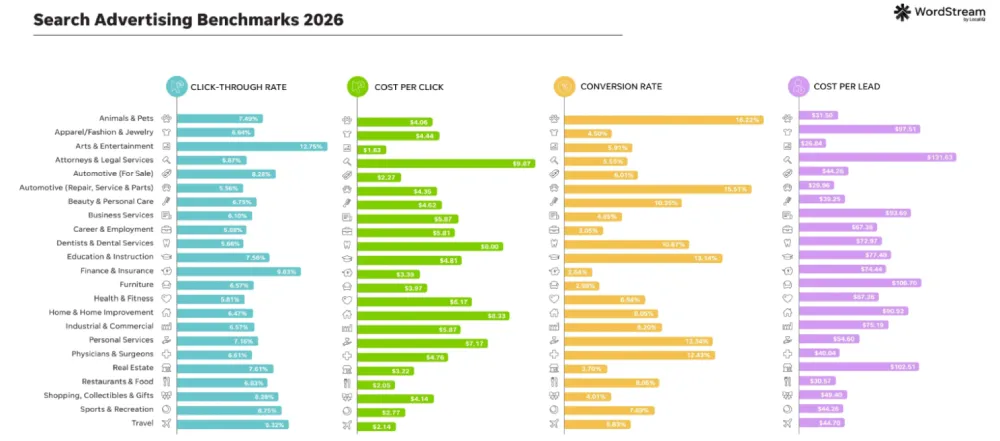
Source: WordStream
So a fixed daily budget can buy very different amounts of traffic depending on what you sell.
Also Read: Google Ads vs Facebook Ads: Which One Generates Better Leads in 2026?
SEO vs Google Ads: Which Costs More?
SEO and Google Ads have different cost structures, so asking which one is cheaper can be misleading. SEO requires ongoing investment in content, technical improvements and authority-building, while PPC charges for each click.
Neither has a fixed universal price.
A better way to judge Google Ads cost is to work backwards from your business economics.
A simple starting point is: Maximum CPC = conversion value × conversion rate × acceptable profit margin. If the numbers don’t support the CPC, increasing the budget won’t fix the problem.
So, is $10 a day enough for Google Ads? It depends. At the $5.42 benchmark CPC, $10 would buy less than two clicks on average.
At an 8.18% conversion rate, even 100 clicks would translate to roughly 8 conversions on the benchmark math, while those 100 clicks would cost about $542.
WordStream’s 2026 US benchmark reports an average $66.69 cost per lead, but actual results vary significantly by industry, location and campaign.
Related Read: How Much Do Google Ads Cost? A Complete Guide to CPC, Budgets & ROI
Should You Use SEO and Google Ads Together?
In many cases, you don’t have to choose between SEO and Google Ads. The two can support each other.
Google Ads gives you speed and testing data, while SEO builds sustainable organic visibility.
For example, you can use PPC to test which keywords, offers and messages actually generate conversions before putting significant SEO resources behind them.
Over time, strong organic rankings can also reduce your dependence on paying for every click.
The key is to measure both channels by conversions and revenue, not traffic alone.
Google provides a Paid & Organic report that lets you compare organic results from Search Console with text-ad performance in Google Ads.
It can also help identify valuable queries where you have organic visibility but little or no paid presence.
For us at Credofy, the practical approach is simple: use Google Ads for speed and SEO for sustainable growth, then let performance data decide where to invest more.
Digital Marketing, SEO & PPC
- SEO to boost rankings and capture high-intent, AI-driven traffic
- Performance Marketing to run ROI-focused campaigns that convert
- Content Marketing to drive clicks, earn links, and build authority
Is SEO Replaced by AI in 2026?
If you’re asking is SEO dead in 2026, the evidence points to a different answer: SEO is changing, not disappearing.
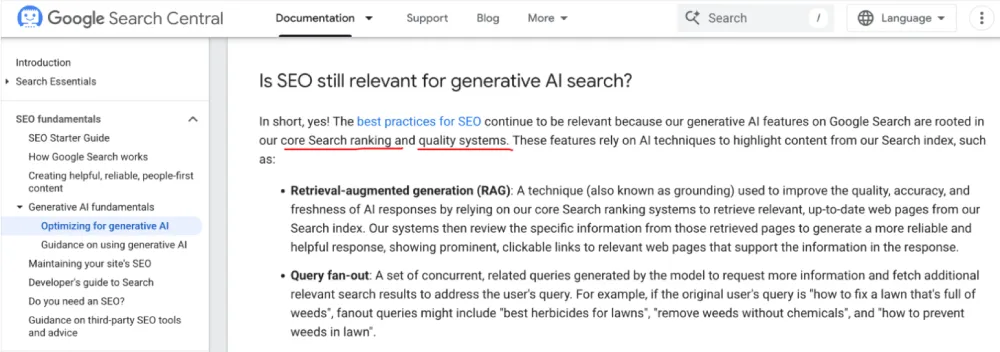
Google says AI Overviews and AI Mode are rooted in its core Search ranking and quality systems, and that foundational SEO practices remain relevant for these AI experiences.
Source: Google Search Central
The bigger change is how people search.
AI Overviews can answer parts of a query directly, while AI Mode supports longer, more conversational searches and follow-up questions.
That can create more zero-click journeys, but it also creates new ways for useful websites to be discovered through supporting links.
In May 2026, Google said AI Mode had passed 1 billion monthly active users globally, while Search queries had reached an all-time high.
That means the value of SEO is shifting toward content that AI systems and people have a reason to trust: original research, first-hand experience, useful information, expert insight, strong brand signals and genuinely differentiated content.
Google’s latest guidance specifically emphasises unique, non-commodity content rather than trying to create pages for every possible AI query.
AI can absolutely help with research, structure and content workflows.
But generating large numbers of low-value pages without adding something useful can fall under Google’s scaled content abuse policy, regardless of whether AI was used to create them.
So, is SEO replaced by AI?
No. The way visibility is earned is evolving.
In fact, Google introduced dedicated Search Console reporting for visibility in AI Overviews and AI Mode in June 2026, giving site owners a way to measure how their content appears in generative AI search experiences.
Related Read: Generative Engine Optimisation (GEO): How to Win Visibility in AI Search (The Complete 2026 Guide)
SEO vs Google Ads: Final Verdict
So, which is better: SEO or Google Ads?
The answer depends on what your business needs right now.
Google Ads is the better choice when you need faster visibility and want to capture high-intent demand quickly. SEO is the better choice when you’re building a long-term source of organic traffic and want visibility that can grow over time.
For many businesses, the smartest approach isn’t choosing one over the other.
Use Google Ads for immediate opportunities and testing, while building SEO to create sustainable organic growth.
At Credofy, we see SEO and paid search as two parts of the same search strategy, not competing channels.
The goal isn’t to get the most clicks. It’s to attract the right visitors and turn them into profitable customers.
In 2026, SEO and Google Ads are less about choosing a winner and more about choosing the right role for each channel.
Frequently Asked Questions
Is SEO better than Google Ads?
Not always. Google Ads can be better when you need immediate traffic and leads, while SEO is usually better for long-term organic visibility. The right choice depends on your budget, competition, search intent and business goals.
Is $10 a day enough for Google Ads?
It can be enough to start testing, but it may not generate enough clicks or conversions in competitive industries. Your CPC, conversion rate and customer value matter more than the daily budget alone.
Is Google Ads considered SEO?
No. Google Ads is paid advertising, while SEO focuses on improving your organic search visibility. They can work together, but paying for Google Ads does not directly improve your organic rankings.
Do Google Ads help SEO?
Google Ads does not directly improve organic rankings. However, paid search data can help you identify valuable keywords, messaging and offers that can inform your SEO strategy.
How much does Google Ads cost compared with SEO?
Google Ads usually involves paying for clicks, while SEO requires investment in content, technical improvements and authority-building. There is no fixed price for either because costs vary by industry, competition and strategy.
Should I use Google Ads and SEO together?
For many businesses, yes. Google Ads can help generate demand and test opportunities while SEO builds long-term organic visibility. Using both also gives you more ways to reach customers throughout the buying journey.
Is SEO replaced by AI?
No. AI is changing how people search and how Google presents information, but SEO is still relevant. The focus is shifting toward useful, original and trustworthy content rather than simply publishing more pages.
Is SEO dead in 2026?
No. SEO is evolving. Businesses now need to think about traditional organic rankings as well as visibility across AI-powered search experiences. Strong technical SEO, useful content, authority and real expertise still matter.
Why choose Google Ads over SEO?
Choose Google Ads when speed matters. It can help you reach people actively searching for your products or services without waiting for organic rankings to develop.
Is SEO worth it in 2026?
For businesses with consistent search demand and a long-term growth strategy, SEO can still be highly valuable. Its biggest advantage is that successful organic visibility can continue generating relevant traffic without paying for every click