
Generative Engine Optimisation (GEO): How to Win Visibility in AI Search (The Complete 2026 Guide)


Generative Engine Optimisation (GEO)
Table of Contents
Serious about growing your business? Let’s plan exactly how to get you more leads, sales, and results—faster.
In 2026, we’re seeing that many businesses are still investing heavily in SEO.
They’re publishing content regularly, building backlinks, and optimising pages to rank higher on Google.
On the surface, this seems like the right approach. But many are still following a playbook built for a version of search that is quickly changing.
Because today, users are not just clicking links—they are getting answers.
Search engines are increasingly showing AI-generated summaries, direct answers, and recommendations at the top of the page. In many cases, users don’t need to visit a website at all.
The data makes this shift clear.
Studies show that around 60% of Google searches now end without a click. At the same time, AI-generated answers can reduce click-through rates on informational queries by 20–40%.
So even if your content ranks well, it doesn’t guarantee visibility anymore.
Users are making decisions before they ever reach your website.
This is exactly where Generative Engine Optimisation (GEO) comes in.
As explained in HubSpot’s GEO guide, it focuses on optimising your content so it can be selected, cited, and used by AI engines like ChatGPT, Perplexity, Claude, and Google AI Overviews when generating answers.
In simple terms, SEO helps you get found. GEO helps you get included.
The Shift from Search Engines to Answer Engines
For years, search followed a familiar pattern.
You typed a query into Google, reviewed a list of results, and clicked through to find your answer. This model was built around discovery—helping users navigate different sources.
That model is now evolving.
Search engines are increasingly becoming answer engines.
For instance, there were over 900 million weekly active users on ChatGPT as of February 2026.
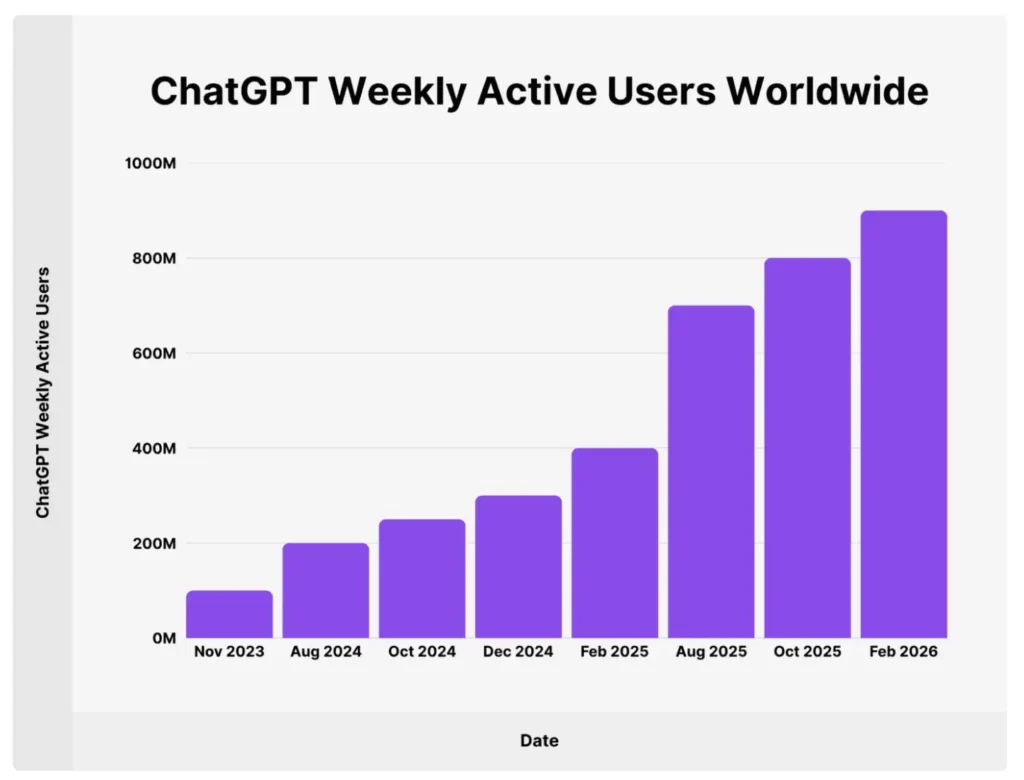
Source: Backlinko
Instead of directing users to websites, they aim to resolve queries directly on the results page using AI-generated summaries.
You’ve likely seen this yourself.
When you search for anything on Google today, you’re often presented with:
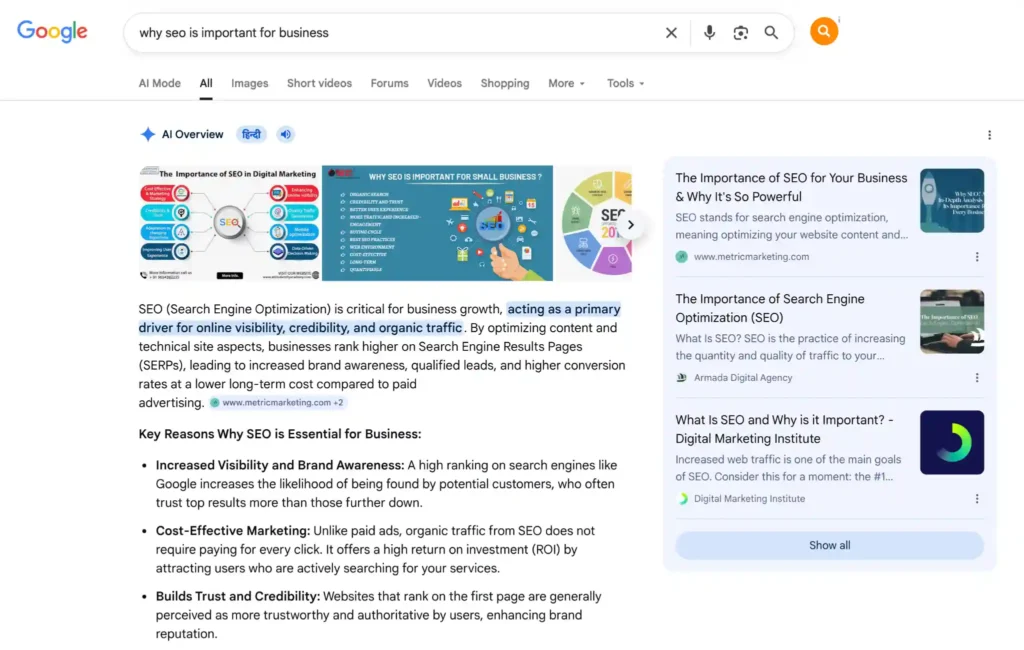
- A complete answer at the top of the page
- A summary compiled from multiple sources
- Key insights structured into a single response
In many cases, users don’t need to go any further.
What’s actually changing?
AI systems analyse multiple sources and deliver a clear, consolidated response in seconds. This removes the need to visit multiple pages.
A significant portion of searches now end without any click, meaning visibility is no longer tied only to traffic.
When an answer is structured, concise, and appears to be backed by multiple sources, users are increasingly willing to trust it without verifying each source individually.
In short, it’s easy to think this is just another algorithm change. But the reality is deeper.
What’s changing is how people search, how they consume information, and how they make decisions.
Before, visibility meant ranking on page one. Success meant getting the click.
Now, visibility means being part of the answer. Success means influencing the decision before the click even happens.
In other words, you don’t need the click to win. But if your brand isn’t showing up in those AI-generated answers, you’re not part of the decision at all.
Must Read: How to Rank #1 on AI Search Engines (with these few simple strategies)
Digital Marketing, SEO & PPC
- SEO to boost rankings and capture high-intent, AI-driven traffic
- Performance Marketing to run ROI-focused campaigns that convert
- Content Marketing to drive clicks, earn links, and build authority

What Is Generative Engine Optimisation (GEO)?
Generative Engine Optimisation (GEO) is the process of optimising your content so it gets picked, cited, and used by AI systems when they generate answers.
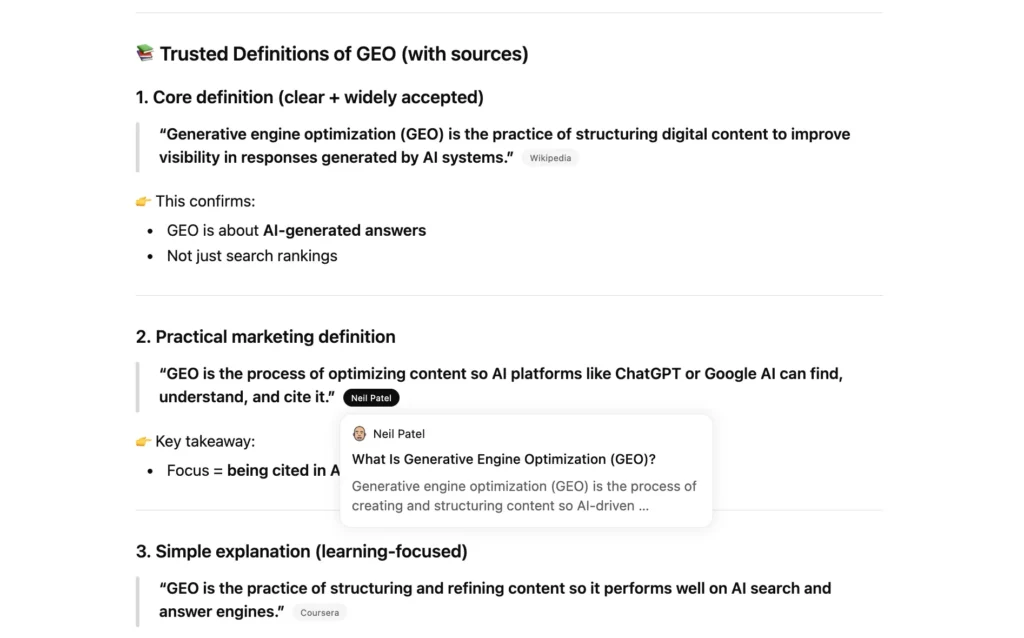
Source: ChatGPT
Instead of focusing only on ranking pages on Google, GEO focuses on making sure your content becomes part of the answer itself.
That includes platforms like Google AI Overviews, ChatGPT, and other AI-powered search tools that summarise information for users.
This is a fundamental shift.
In traditional SEO, your goal was to rank higher so users could find and click your page. With GEO, your goal is different. You want your content to be selected and included when AI builds a response.
Because AI doesn’t just rank content—it reads, rewrites, and compresses information from multiple sources into a single answer.
That means your visibility is no longer limited to your website.
GEO vs SEO: What Changed and What Didn’t
GEO doesn’t replace SEO. It builds on it.
A lot of the fundamentals still apply. But the way visibility works has changed. Instead of optimising only for rankings, you now need to optimise for inclusion in AI-generated answers.
Let’s break this down clearly.
Some things haven’t changed—and they’re still critical.
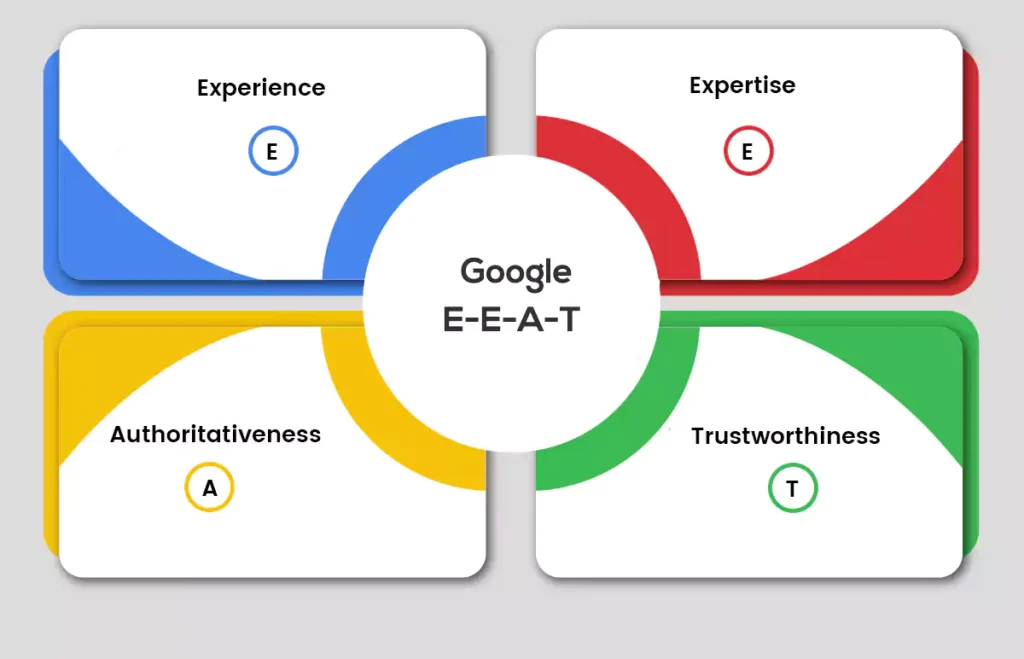
E-E-A-T is still the foundation
Experience, Expertise, Authoritativeness, and Trust are more important than ever. AI systems rely heavily on trusted sources when generating answers. If your content lacks credibility, it’s unlikely to be used.
Content quality and intent alignment still drive performance
You still need to create content that answers real user questions. If your content doesn’t match intent, it won’t rank—and it won’t get picked by AI either.
Technical SEO still enables discoverability
Search engines and AI systems still need to find and understand your content. Clean structure, proper indexing, and strong site performance are still essential.
In most cases, AI systems pull information from top-ranking or highly trusted pages. So strong SEO increases your chances of being included.
This is where the real shift happens.
It’s no longer just about targeting keywords. AI focuses on understanding topics, relationships, and context. Your content needs to clearly connect ideas, not just match phrases.
Marketing Research & Strategy
We help you understand your market and build smart strategies to attract more customers and grow faster.
- Detailed research into your competitors, customers, and market
- Custom marketing and growth plans that drive real results
- Clear action steps to increase traffic, leads, and sales

ADWORDS ROI

Cut Ad spend

Ranking #1 is no longer the end goal. Your content needs to be selected as part of the final answer that users see.
AI doesn’t use your entire page. It pulls specific sections, summaries, and key points. If your content isn’t structured clearly, it becomes difficult to extract—and less likely to be used.
Links still matter, but brand mentions across trusted sources are becoming just as important. AI looks for signals of authority across the web, not just your backlink profile.
The most important shift to understand is this:
AI doesn’t “rank” a single page.
It builds an answer by combining insights from multiple sources.
And your goal is to be one of them.
Recommended Read: How to Do Answer Engine Optimisation (AEO): Top Strategies to Use in 2025
How AI Search Engines Actually Work (In Simple Terms)
To understand GEO, you need a simple view of how AI search works.
Unlike traditional search engines that rank and display links, AI systems build answers. They pull information from different sources and combine it into a single response that the user sees.
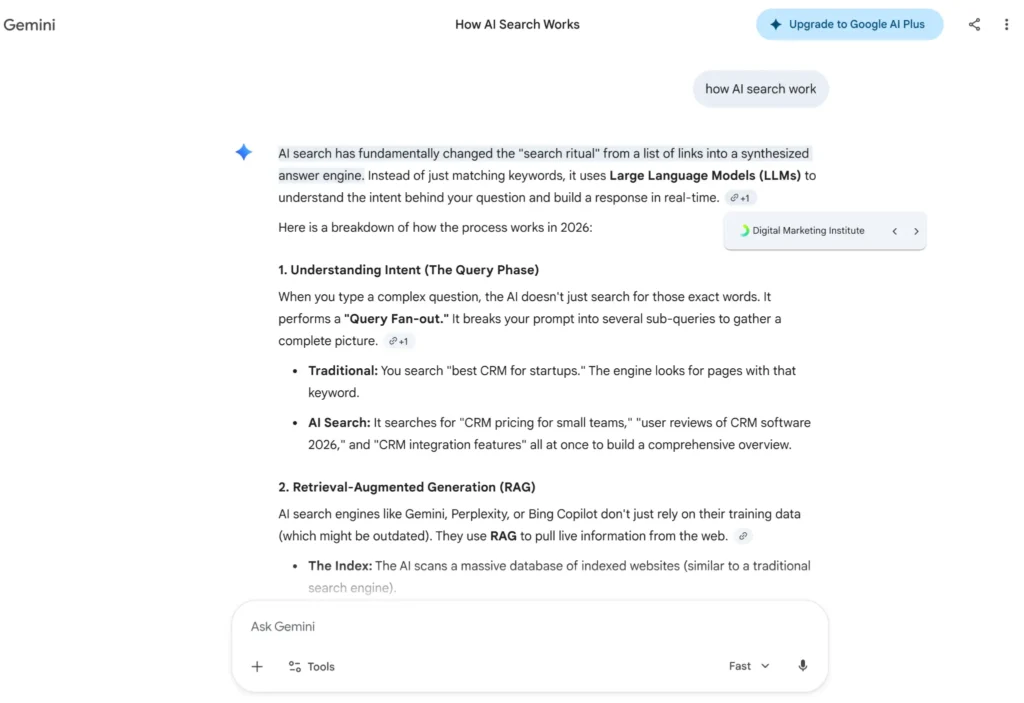
Source: Google Gemini
This process happens in two steps: retrieval and generation.
First, the AI finds relevant sources. It looks for content that clearly matches the query, is easy to understand, and comes from trusted domains.
In most cases, this includes well-structured pages that already perform well in search or show strong authority signals.
Then comes the generation.
The AI takes key points from multiple sources, rewrites them, and combines them into one clear answer.
Users don’t see your full page—they only see the parts that the AI extracts and considers useful.
This entire system is often called Retrieval-Augmented Generation (RAG). In simple terms, it means the AI doesn’t rely on one source. It gathers information from several places and builds a single, summarised response.
Because of this, the type of content you create matters a lot.
AI systems consistently prefer content that is clear, structured, and easy to extract.
Direct definitions, well-organised sections, and concise explanations are far more likely to be used than long, unstructured paragraphs. Authority also plays a key role—content from trusted sources is more likely to be selected.
The most important thing to understand is this:
Even high-quality content can get ignored if it’s hard to extract.
If your content isn’t structured in a way that AI can easily pull from, it simply won’t be used. And if it’s not used, you don’t show up in the answer.
Also Read: The Future of SEO Marketing (2026 Edition): Best Practices, Tools, and Costs Explained
Why GEO Matters for Businesses
Now that you understand how AI search works and how it selects content, the next question is simple:
Why does this actually matter for your business?
For years, SEO was predictable. Rank higher, get more traffic, generate more leads. But that relationship is starting to break.
Because AI is changing where decisions happen.
1. Traffic is becoming less reliable
Traffic used to be the main goal of SEO.
But today, a large share of searches end without a click. Users get their answers directly from AI, which means they don’t always need to visit your website.
So even if you rank, you might not see the same level of traffic.
This doesn’t mean your content isn’t working. It just means visibility is happening in a different place.
2. Influence is shifting earlier
If traffic is going down, influence is moving up.
When someone reads an AI-generated answer, they’re not just learning. They’re forming an opinion. And that happens before they decide to visit any website.
So if your brand appears in that answer, you influence the decision early. If it doesn’t, someone else does.
3. Informational content is hit the hardest
This shift is most visible in informational searches.
Queries like “what is,” “how to,” or “best ways to” are now often fully answered by AI. These are the exact moments where users are researching and comparing options.
And increasingly, they’re doing that without clicking through.
That means a large portion of your top-of-funnel content is being impacted.

4. Fewer clicks, but higher intent
However, fewer clicks doesn’t always mean less value.
In many cases, the clicks you do get are more valuable.
By the time someone visits your site, they’ve already done their research. They understand the problem, they’ve seen possible solutions, and they’re closer to taking action.
That means higher intent and better conversion potential.
5. Trust transfer from AI mentions
There’s also a shift happening in how trust is built.
When your brand is mentioned inside an AI-generated answer, it creates an immediate sense of credibility. Users assume that if the AI included you, you’re a reliable source.
This builds trust before they even interact with your website.
The key takeaway?
When you connect all of this, one thing becomes clear.
You don’t need the click to influence the decision anymore.
But if your brand isn’t part of that AI-generated answer, you’re not part of the decision at all.
And in a world where visibility is happening inside the answer, being skipped means being invisible.
Also Read: 10 Google SEO Guidelines for 2025–2026: Master E-E-A-T & Core Updates to Rank Higher
Digital Marketing, SEO & PPC
- SEO to boost rankings and capture high-intent, AI-driven traffic
- Performance Marketing to run ROI-focused campaigns that convert
- Content Marketing to drive clicks, earn links, and build authority
What Content Gets Picked by AI (Patterns That Win)
Now that you understand why GEO matters, the next step is execution.
Because this is where most businesses fall behind.
They’re still creating content for rankings, not for AI selection. But as we’ve already seen, ranking alone doesn’t guarantee visibility anymore. Your content needs to be usable inside an answer.
And the data clearly supports this shift.
Studies show that AI Overviews can reduce organic CTR by around 61%, depending on the query type.
At the same time, as we mentioned earlier, over 60% of searches now result in zero clicks, with AI summaries playing a major role in this behaviour.
So the real question isn’t just:
“Does your content rank?”
It’s:
1. Start with direct answers
AI prefers content that resolves the query immediately.
If someone is searching for a definition or explanation, your content should answer it clearly in the first few lines. Long introductions and vague openings make it harder for AI to extract useful information.
2. Use summaries, then go deeper
One of the most effective structures is simple.
Start with a clear summary. Then expand with a deeper explanation.
This gives AI something quick to extract, while still providing enough context if it needs more detail. It also improves readability for users.
3. Structure content with lists and frameworks
Unstructured content is difficult for AI to process.
But lists, frameworks, and comparisons break information into clean sections. This makes it easier for AI to extract specific points and include them in answers.
4. Include clear definitions
Definition-style content is one of the most commonly used formats in AI responses.
In fact, nearly 100% of queries triggering AI Overviews are informational, meaning they rely heavily on clear explanations.
If your content includes strong “what is” sections, it becomes much easier for AI to use it.
5. Support with data and facts
Content backed by data stands out.
AI systems tend to prioritise information that includes credible statistics, research, or unique insights, because it strengthens the final answer.
We’re also seeing that being cited inside AI Overviews can increase clicks significantly compared to not being cited, even in a declining CTR environment.
So data doesn’t just improve authority—it improves your chances of being selected.
6. What AI consistently prefers
When you look across all of these patterns, there’s a clear trend.
AI favours content that is:
- Easy to quote
- Easy to summarise
- Factually dense
If your content checks these boxes, it becomes far more likely to be used.
Digital Marketing, SEO & PPC
- SEO to boost rankings and capture high-intent, AI-driven traffic
- Performance Marketing to run ROI-focused campaigns that convert
- Content Marketing to drive clicks, earn links, and build authority
The Core Principles of GEO
By now, one thing should be clear.
GEO isn’t about tricks or hacks. It’s about aligning your content with how AI actually selects and uses information.
From what we’ve seen across platforms, the content that consistently gets picked follows a few core principles. If you get these right, everything else becomes easier.
1. Answerability
At the core of GEO is a simple idea: does your content directly answer the query?
AI systems are designed to find clear, immediate answers. If your content takes too long to get to the point, it becomes harder to extract and less likely to be used.
This is where many businesses go wrong.
They start with long introductions, background context, or generic explanations. That might work for traditional SEO, but in AI search, it creates friction.
Instead, your content should resolve the query early.
Start with a clear answer. Then expand.
The easier it is for AI to identify the answer, the more likely it is to include your content.
2. Structure
Even great content can get ignored if it’s poorly structured.
AI doesn’t read like a human. It scans for patterns, sections, and clear signals. If your content is organised well, it becomes much easier to break down and reuse.
This means:
- Using question-based headings that match real queries
- Breaking content into clear sections
- Supporting with bullet points and short paragraphs
- Including summaries where needed
When each section of your content can stand on its own, it becomes far more usable.
Think of it this way.
Every section should feel like something that could be quoted independently inside an answer.
3. Authority
AI doesn’t just look for information. It looks for reliable information.
That’s where authority comes in.
Content that includes backed claims, credible sources, and real expertise is more likely to be selected. Opinions without support are far less useful in an AI-generated response.
This is also why we’re seeing trusted domains appear more frequently in AI answers.
If your content shows:
- Clear expertise
- Supporting data or examples
- Consistent credibility
…it becomes a stronger candidate for inclusion.
4. Entity Clarity
AI doesn’t just evaluate pages. It evaluates entities—brands, topics, and how they connect.
If your brand isn’t clearly associated with a topic, it becomes harder for AI to recognise your relevance.
That’s why consistency matters.
Your content, website, and presence across platforms should reinforce the same core association. Whether it’s SEO, real estate marketing, or lead generation, your positioning needs to be clear and repeated.
The stronger this connection, the easier it is for AI to understand where you fit—and when to include you.
5. Off-Site Presence
Finally, GEO doesn’t stop at your website.
AI systems pull information from multiple sources, not just one domain. That means your visibility depends on how often your brand appears across the wider web.
This includes:
- Mentions on other websites
- Guest posts and PR features
- Discussions in communities and forums
- Third-party validation and references
The more your brand shows up in credible places, the stronger your overall authority becomes.
And the more likely it is that AI will include you when generating answers.
If you’re into real estate niche, then you might also like reading:
Estate Agent SEO 2026: How Top UK Agencies Get 50–300+ Free Google Leads Every Month
How to Build a GEO Strategy (Step-by-Step)
Now that you understand how GEO works, the next step is applying it.
Because this is where most businesses struggle.
They either overcomplicate it… or they keep doing traditional SEO and expect different results. But GEO requires a shift—not in effort, but in focus.
Here’s how you approach it in a practical way.
1. Identify high-intent questions
Everything starts with understanding what people are actually asking.
Not just keywords, but real questions.
AI systems are designed to answer queries, not match phrases.
So instead of thinking, “What keyword should I target?”, you need to ask, “What problem is the user trying to solve?”
You’ll start noticing patterns quickly:
- “What is…” queries
- “How to…” searches
- Comparisons and decision-based questions
For this you can also use tools like Answer Socrates or Answer the Public.
For example, when you search a keyword like property investment in London on Answer Socrates, you’ll see a cluster of suggested user queries.
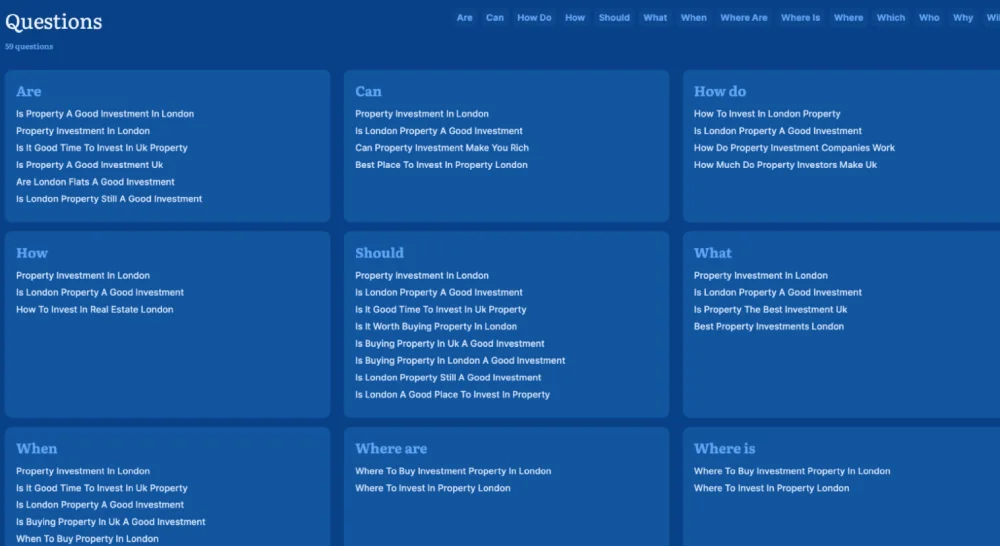
Source: Answer Socrates
These aren’t just suggestions; they’re a direct reflection of what people are actively asking.
That makes them a strong starting point. If you build content that answers these questions clearly, you increase your chances of showing up in AI-driven search results.
Aside from these, you can also look at Google results, especially the ” People Also Ask ” section.
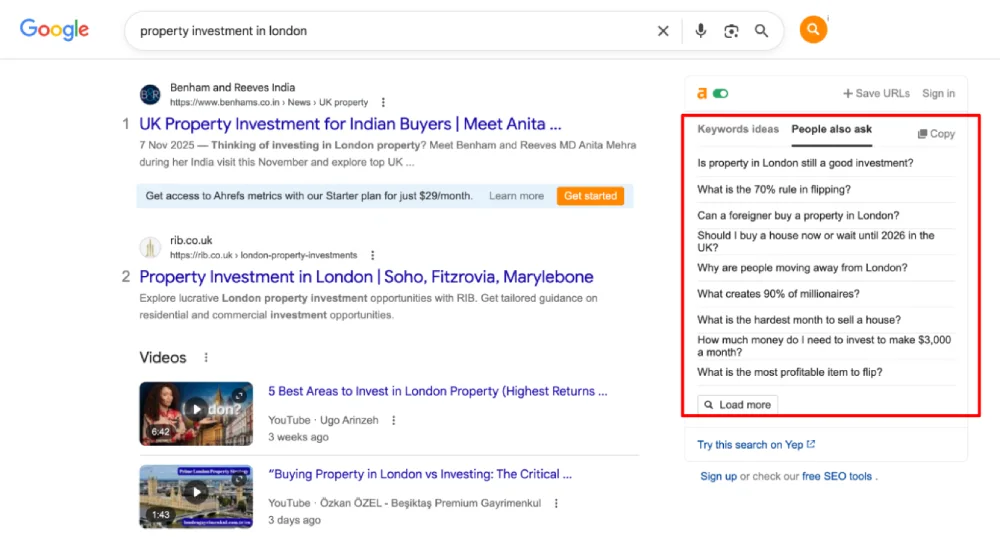
Look at Reddit threads. Look at how real users phrase their questions.
That’s where the real intent lives.
2. Audit your AI visibility
Before you jump into creating anything new, figure out where you already stand.
Start by searching your core topics on platforms like ChatGPT, Google AI Overviews, or Perplexity AI. Look closely at which brands keep showing up.
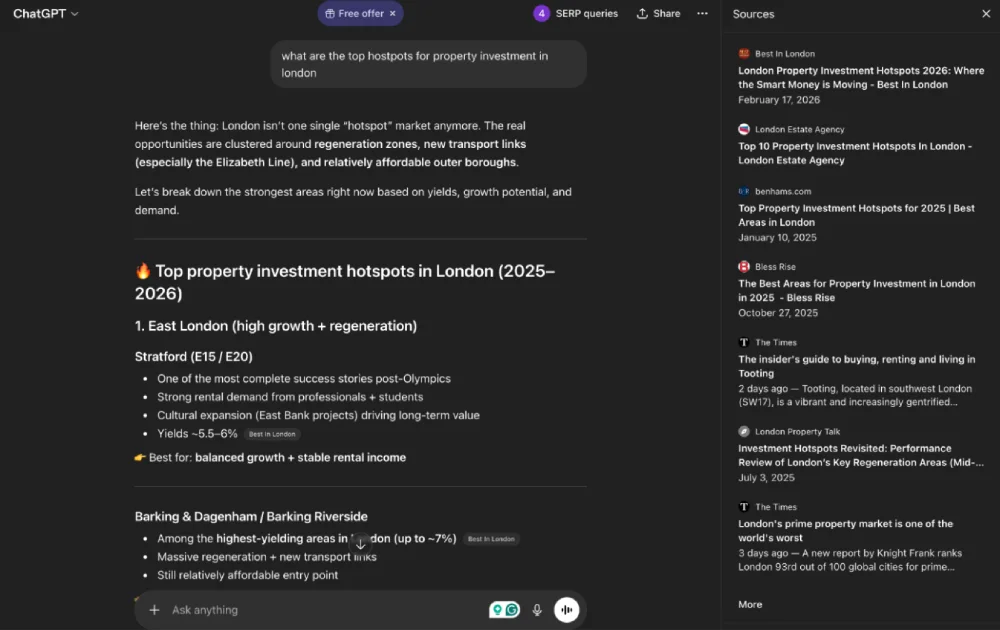
Source: ChatGPT
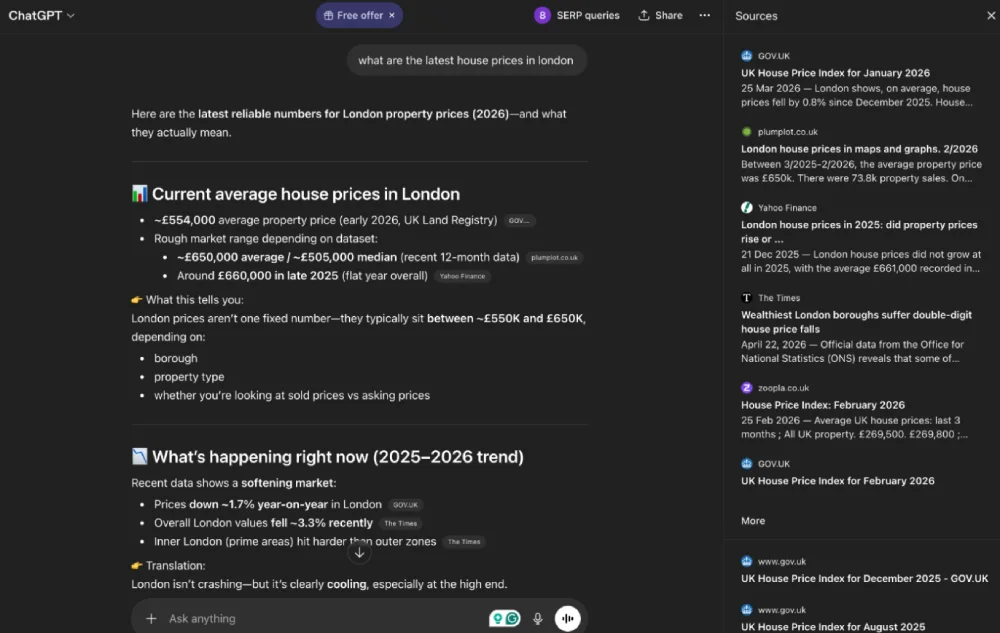
Source: ChatGPT
Say you’re an estate agent in London. You might notice The Times appearing again and again.
That’s not a coincidence.
The same names surface repeatedly because their content is structured well, easy for AI to interpret, and carries authority.
Now turn the lens on yourself.
Are you showing up at all?
If not, who is?
And more importantly, what kind of content is getting picked?
This step isn’t just observation—it gives you a clear picture of the gap between where you are and where you need to be.
3. Create content designed to be used
This is the shift most businesses miss.
They create content to rank.
But in GEO, you need to create content that can be used inside an answer.
That means thinking differently while writing.
Instead of long, continuous explanations, break things down. Add clear definitions. Use comparisons. Walk through steps where needed.
You’re not just writing for a reader anymore.
You’re structuring content so it can be lifted, reused, and placed into an AI-generated response without friction.
4. Fix the way your content is structured
At this point, it’s not just about what you say—it’s how you present it.
Even strong content can get ignored if it’s difficult to extract.
So focus on making it easier to process:
- Add short summaries where it makes sense
- Keep paragraphs tight and readable
- Use lists only when they genuinely improve clarity
- Make sure each section stands on its own
A good test is simple.
If someone reads just one section of your page, does it still make sense? If yes, AI can likely use it too.
5. Build authority beyond your website
This is where GEO expands beyond traditional SEO.
Your website is just one part of the picture.
AI systems look across multiple sources to decide what to include.
So your visibility needs to exist beyond your own domain.
This could mean:
- Getting mentioned in industry articles
- Contributing insights to other platforms
- Being active in communities where your audience is present
- Building a presence that extends beyond your website
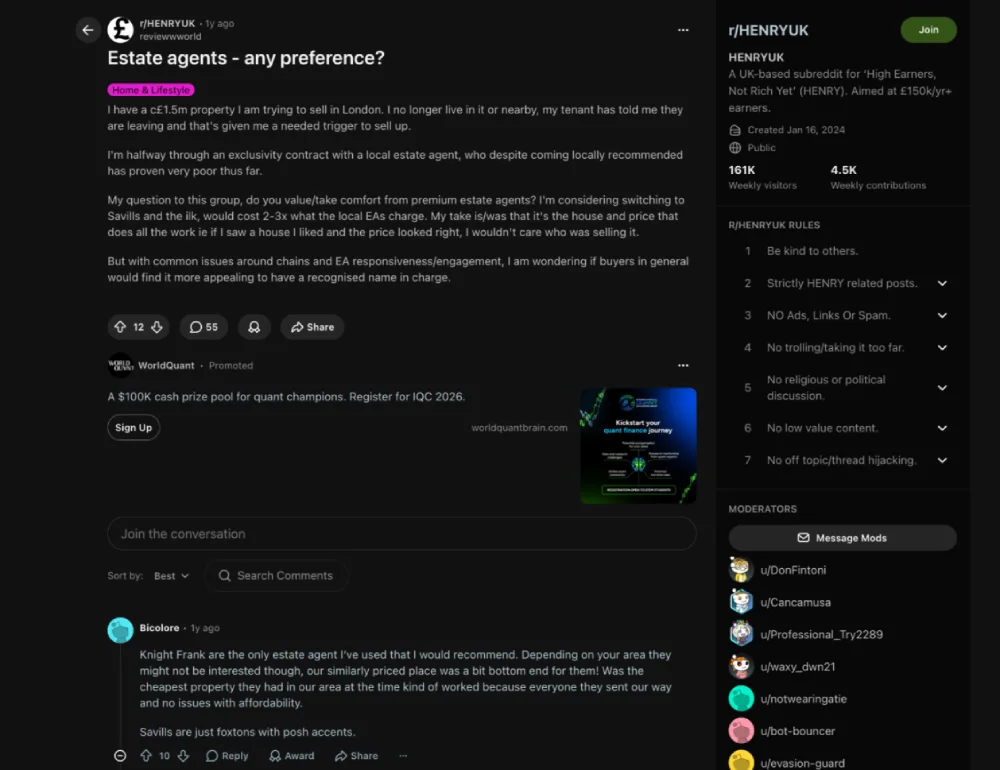
For example, even discussions on Reddit can matter.
If people are naturally mentioning your brand in relevant threads, whether in recommendations, comparisons, or experiences, that becomes another signal of credibility and real-world relevance.
Source: Reddit
For instance, you see a user recommending a brand like Knight Frank when someone asks for estate agent suggestions.
These kinds of organic mentions show how your brand is being discussed in context, not just promoted.
The more your brand shows up in trusted places like this, the stronger your overall authority becomes.
And the stronger the authority, the higher your chances of being included in AI-generated answers.
Digital Marketing, SEO & PPC
- SEO to boost rankings and capture high-intent, AI-driven traffic
- Performance Marketing to run ROI-focused campaigns that convert
- Content Marketing to drive clicks, earn links, and build authority
How to Measure GEO Performance
GEO doesn’t show up in traditional metrics the same way SEO does. So you need to track the right signals.
What to focus on:
- AI mentions and citations
→ Are you appearing in ChatGPT, Google AI, and Perplexity answers? - Share of voice
→ How often are you mentioned vs competitors? - Branded search growth
→ More people searching your brand after seeing it in answers - Conversion quality
→ Fewer clicks, but better leads and higher intent
What matters less now:
- Rankings alone
- Raw traffic numbers
Common Mistakes to Avoid
Most businesses don’t fail at GEO because it’s complex.
They fail because they’re still thinking in the old SEO model.
Avoid these mistakes:
- Writing for keywords instead of real questions
- Over-explaining without giving a clear answer upfront
- Poor or inconsistent content structure
- Ignoring off-site signals and brand mentions
- Treating GEO as a trend instead of a shift
- Weak formatting (no hierarchy, hard to extract content)
Conclusion: The Future of GEO
Everything we’ve covered points to one clear direction.
Search is no longer just about finding information. It’s about getting answers instantly.
And that shift is only accelerating.
We’re moving toward a world with:
- More zero-click experiences
- AI is becoming the default interface for search
- Decisions being made before users visit a website
In that world, rankings alone won’t be enough.
Authority will matter more than position.
Being cited will matter more than being listed.
Because AI doesn’t just show results—it recommends, summarises, and influences decisions.
And that leads to one simple truth:
The brands that get cited will outperform the ones that just rank.
Marketing Research & Strategy
We help you understand your market and build smart strategies to attract more customers and grow faster.
- Detailed research into your competitors, customers, and market
- Custom marketing and growth plans that drive real results
- Clear action steps to increase traffic, leads, and sales
ADWORDS ROI
Cut Ad spend
Get Your Brand Cited in AI Search (Take the First Step)
If you want your business to be mentioned, cited, and recommended across platforms like ChatGPT, Google Gemini, and Grok, you need a strategy built for how search works today, not how it worked before.
If you’re serious about staying ahead, we can help you map that out.
Book a free strategy session with our marketing experts at Credofy, and we’ll show you exactly how to position your business to win in this AI-driven search era.
Frequently Asked Questions
What is generative engine optimisation?
Generative Engine Optimisation (GEO) is the process of optimising your content so it gets selected, cited, and used by AI systems like ChatGPT and Google AI when generating answers.
How does generative engine optimisation work?
GEO works by structuring your content so AI systems can find, extract, and use it in answers. This includes clear definitions, structured sections, trusted sources, and content that directly answers user queries.
What generative engine optimisation matters?
GEO is about getting your content included in AI answers, not just ranked. It matters because users are increasingly relying on AI summaries, meaning visibility now happens before the click.
Is GEO replacing SEO?
No. GEO is not replacing SEO, it’s building on top of it. SEO helps your content get discovered, while GEO ensures it gets included in AI-generated answers. You need both to stay visible.
Is SEO dead or evolving in 2026?
SEO is not dead—it’s evolving. Traditional rankings still matter, but visibility is shifting toward AI-generated answers, making GEO a critical extension of SEO.
What are the 4 types of SEO?
The four main types of SEO are:
- On-page SEO (content, keywords, structure)
- Off-page SEO (backlinks, mentions)
- Technical SEO (site speed, indexing, crawlability)
- Local SEO (location-based visibility and Google Business Profile)
How to do GEO (Generative Engine Optimisation)?
To do GEO effectively:
- Focus on real user questions, not just keywords
- Write clear, direct answers
- Structure content with headings and summaries
- Add data, examples, and credibility signals
- Build authority across multiple platforms, not just your website