
15 Best AI SEO Tools for Businesses to Try in 2026


Best AI SEO Tools for Businesses
Table of Contents
Serious about growing your business? Let’s plan exactly how to get you more leads, sales, and results—faster.
SEO in 2026 is no longer just about ranking on Google.
It’s about showing up wherever your customers are searching, and turning that visibility into enquiries and revenue.
Today, search doesn’t happen in one place.
Your audience is using Google, AI platforms like ChatGPT and Google Gemini, and often getting answers without even clicking a website.
In fact, studies show that a large percentage of searches now end without a click, meaning your business needs to be visible inside answers, not just search results.
This shift has changed how AI tools for SEO work.
Modern AI SEO tools are no longer just about keywords or rankings. The best ones help you:
- Get featured in AI-generated answers
- Build topical authority that search engines trust
- Turn traffic into real leads and customers
That’s why choosing the right AI SEO software matters more than ever.
This guide isn’t about tools that help you rank.
It’s about the best AI SEO tools that help your business get visibility, leads, and real growth.
How does SEO Look Like in 2026
Most businesses still think SEO is about ranking on Google.
That worked before. It doesn’t work the same way anymore.
What we’re seeing now is a clear shift; SEO is no longer just about rankings. It’s about visibility across multiple platforms where your customers are actually searching.
Today, your customer might:
- Search on Google
- Ask ChatGPT for recommendations
- Use Perplexity AI to research options
- Or explore answers inside Google Gemini
And in many cases, they never click on a website.
We’re already seeing this in the data — a large percentage of searches now end without a click, especially with AI-generated answers and summaries. So even if you’re ranking, it doesn’t guarantee visibility anymore.
What Visibility Actually Means in 2026
From our experience working with businesses, visibility today comes from three key places:
- Google rankings → still important, but only one part of the picture
- AI citations → your content being referenced inside AI answers
- Brand mentions → across trusted platforms, forums, and content ecosystems
This is where most businesses fall behind. They’re still focused only on rankings, while search itself has already evolved.
Digital Marketing, SEO & PPC
- SEO to boost rankings and capture high-intent, AI-driven traffic
- Performance Marketing to run ROI-focused campaigns that convert
- Content Marketing to drive clicks, earn links, and build authority
The Shift: From SEO to GEO
This shift has introduced something new:
GEO (Generative Engine Optimisation)
Instead of only optimising for search engines, we now optimise for AI engines that generate answers.
That means:
- Creating content AI can easily understand and extract
- Covering topics in depth, not just targeting keywords
- Building authority so your brand gets referenced, not ignored
- SEO helps you rank
- GEO helps you get chosen
And in 2026, you need both.
If you’re still relying only on traditional SEO tactics — chasing keywords, publishing content without depth, or focusing only on traffic — you’ll struggle to compete.
The businesses that are winning right now are using modern AI SEO tools and AI SEO software to make sure they’re visible everywhere their customers search, not just on Google.
Must Read: How to Rank #1 in Google AI Mode (Complete Guide)
What Actually Matters Now (Before You Pick Any Tool)
Before you start exploring different AI tools for seo, it’s important to understand this:
Most businesses don’t struggle because they lack tools.
They struggle because they focus on the wrong things.
Here’s what actually matters in 2026:
1. Visibility
As we mentioned earlier, ranking #1 doesn’t guarantee results anymore.
If your business isn’t showing up in AI answers, featured snippets, or brand mentions, you’re missing opportunities — even with top rankings.
Today, visibility = Google + AI + everywhere your audience searches
2. Content Depth
Old SEO was about inserting keywords.
Now, search engines (and AI) look for complete, helpful answers.
That means:
- Covering the topic fully
- Answering real questions
- Structuring content clearly
This is where modern SEO writing AI and SEO content writing tools actually help — not to write more, but to write better and deeper.
3. Authority
Publishing 50 average blogs won’t move the needle.
But 5 strong, well-structured, expert-level pieces can.
Search engines now prioritise:
- Experience
- Expertise
- Trust
It’s not about how much you publish, it’s about how much you’re trusted.
4. Conversion
This is where most businesses get it wrong.
They chase traffic, not results.
Here’s the reality:
- A page with 10,000 visitors and no enquiries = zero business impact
- A page with 2,000 visitors and a 5% conversion rate = real revenue
That’s why the best AI SEO tools today are not just focused on rankings — they help you:
- Attract the right audience
- Structure content for action
- Turn visitors into leads
How We Selected These AI SEO Tools
There are hundreds of AI tools for SEO out there.
Most look good on paper, but very few actually help a business grow.
So we kept this simple and practical.
Every tool in this list is based on what actually works in 2025–2026:
- Real business use cases → not built just for SEO teams, but usable by founders and teams
- AI + GEO capability → helps you show up in both Google and AI search results
- Ease of use → no technical complexity or steep learning curve
- ROI impact → can it turn traffic into leads, not just rankings
- Automation level → saves time, not adds more work
- Proven adoption → widely used and evolving with modern search
In short, we didn’t pick tools that just “look smart.”
We have picked tools that actually help businesses get visibility, leads, and growth.
The 15 Best AI SEO Tools for 2026 (Categorised for Businesses)
Most lists just throw tools at you.
That’s not helpful.
Instead, we’ve grouped the best AI SEO tools by what your business actually needs, so you can quickly decide what fits your stage and goals.
All-in-One SEO Platforms (Best for Growth Strategy)
If you want a complete system — not just isolated tools — start here.
These platforms combine research, tracking, content, and performance into one place.
What’s driving their importance is adoption. Over 70% of marketers actively use SEO tools to improve visibility and performance, and all-in-one platforms are becoming the default choice for managing everything in one place.
Semrush
Source: Semrush
Best for: Full business visibility (Google + AI search)
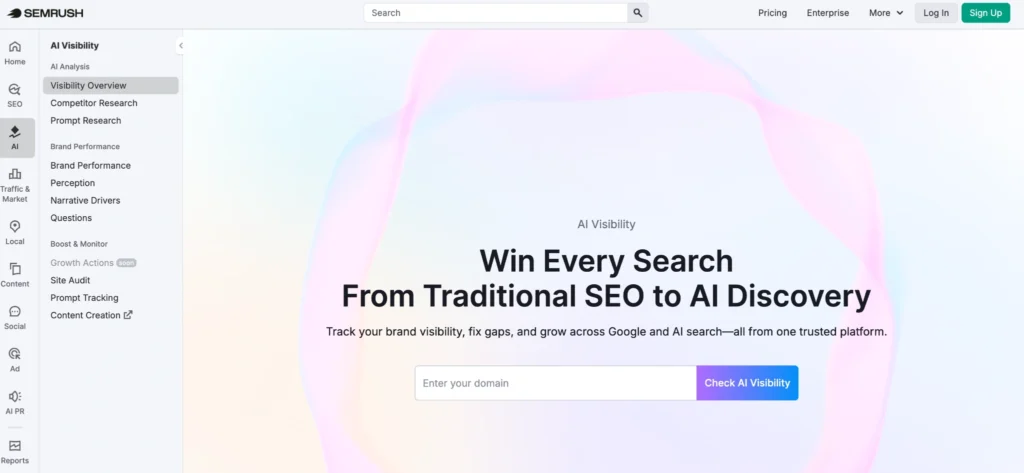
If you want one platform that covers almost everything, this is it. In 2026, Semrush AI features have evolved beyond keyword tracking; it now helps you understand where your brand appears across both Google and AI-generated results.
For most businesses, this becomes the control centre for SEO decisions.
Key features:
- AI Visibility Score (tracks presence in AI answers)
- Competitor intelligence and gap analysis
- Keyword, backlink, and PPC data in one place
- Content and site audit tools
Why it matters:
You’re not just tracking rankings — you’re seeing where your brand actually shows up.
Also Read: 15 Best Tools to Track Your Brand in ChatGPT, Gemini, Claude & Perplexity in 2026
Ahrefs
Source: Ahrefs
Best for: Competitor + backlink dominance
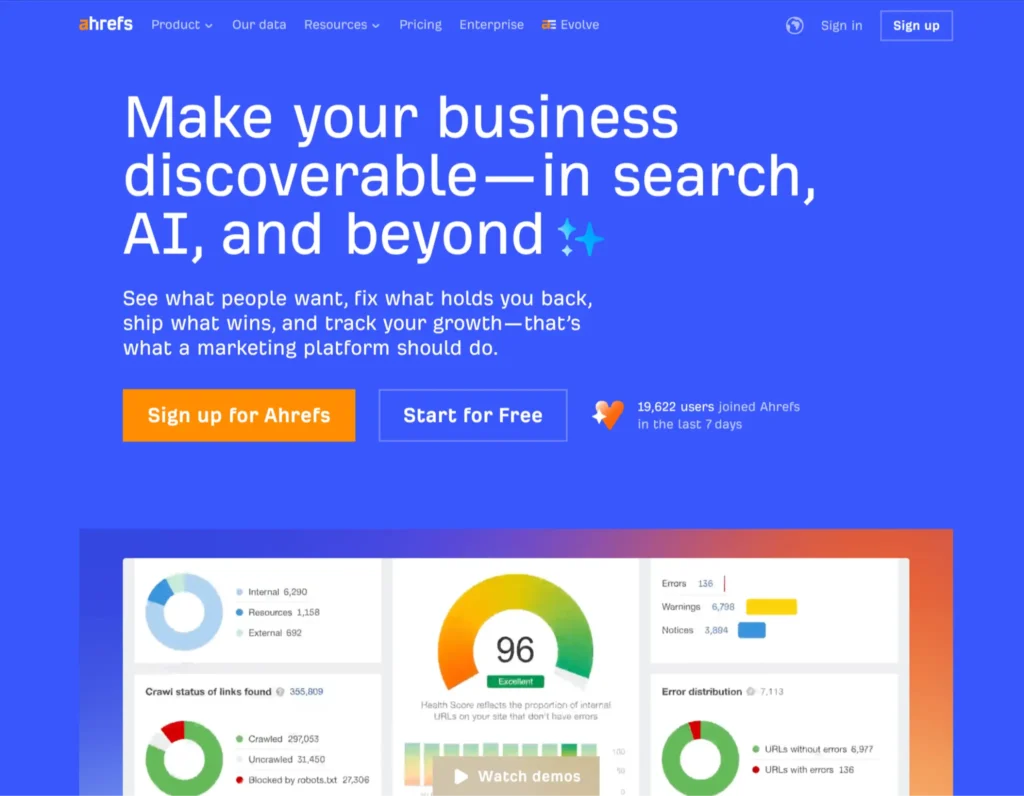
Ahrefs is still one of the strongest data-driven AI SEO software platforms. What makes it powerful is how clearly it shows what your competitors are doing — and where you’re missing opportunities.
If your growth depends on outranking competitors, this tool is hard to ignore.
Key features:
- Massive backlink database
- AI-powered content gap analysis
- Keyword and traffic insights
- Competitor research
Business use:
Find exactly where competitors are getting traffic and leads — and replicate it.
SE Ranking
Source: SE Ranking
Best for: Affordable all-in-one solution
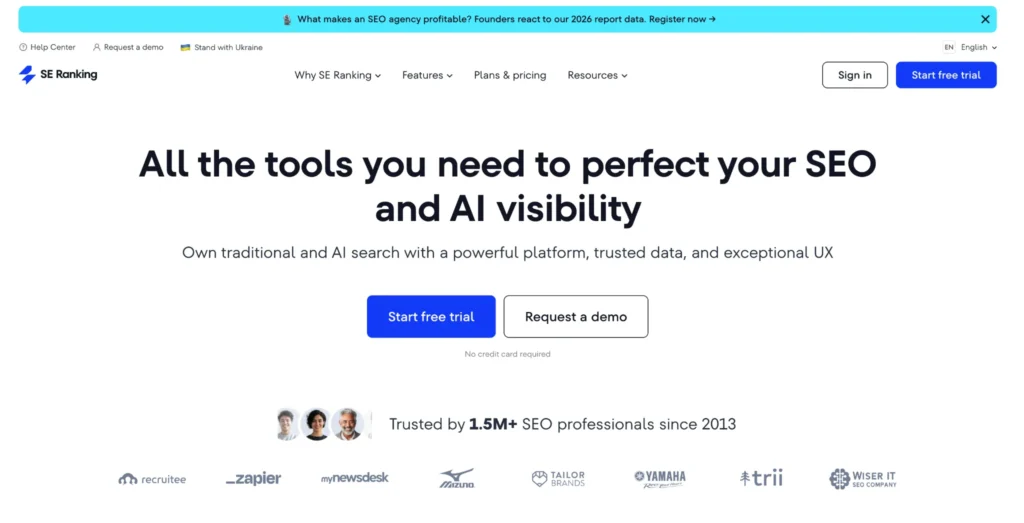
If you want something simpler and more cost-effective, SE Ranking is a solid choice. It gives you most of the core features of larger platforms, without the complexity or pricing.
With SEO budgets tightening for many SMBs, tools like this are growing fast as businesses look for cost-effective alternatives without losing core functionality.
For small and growing businesses, this is often the easiest entry into modern SEO AI tools.
Key features:
- AI-powered rank tracking and audits
- Keyword research and competitor analysis
- GEO (AI visibility) tracking
- Clean, easy-to-use dashboard
Best for SMBs:
Get the essentials without paying for enterprise-level tools.
Content & On-Page SEO (Where Rankings Are Won)
This is where most results are decided.
You can have the best strategy, but if your content isn’t structured properly, it won’t rank — or get picked up by AI. These SEO content writing tools and SEO writing AI platforms help you create content that actually performs.
Surfer SEO
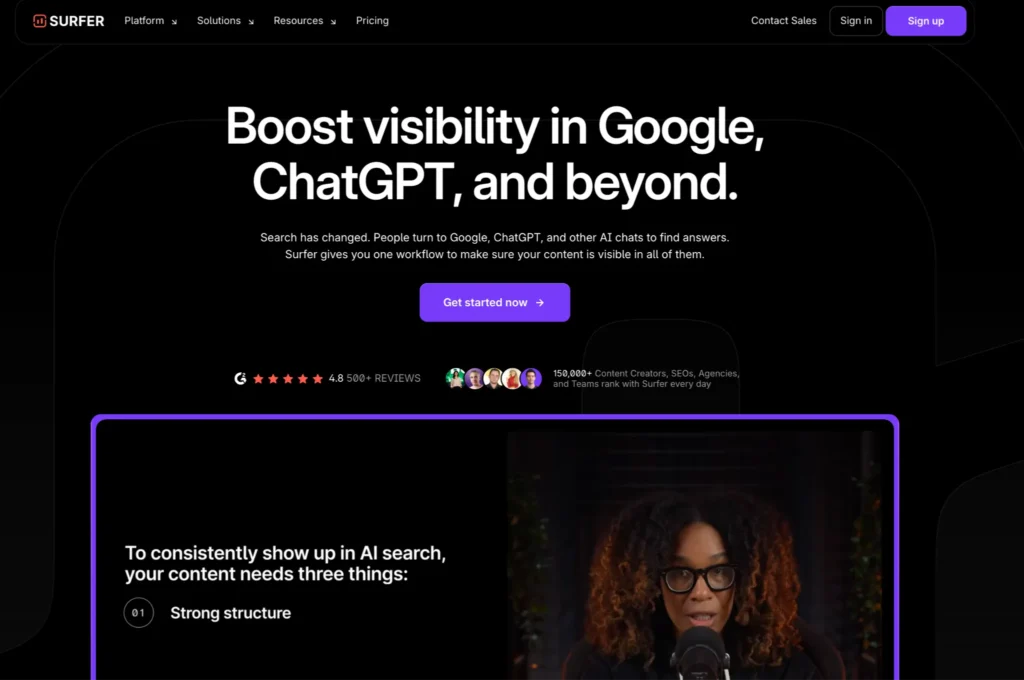
Source: Surfer
Best for: Ranking pages faster
Surfer is one of the most practical AI SEO tools when it comes to improving on-page performance. It analyses top-ranking pages in real time and tells you exactly what your content needs to compete.
For businesses that want faster results without guessing, this is a strong choice.
Key features:
- Real-time SERP analysis
- NLP-based entity optimisation
- Content scoring and structure guidance
- Integration with AI writing tools
Impact: Turns your content into something that’s actually built to rank — not just written.
Related Read: The Future of SEO Marketing (2026 Edition): Best Practices, Tools, and Costs Explained
Clearscope
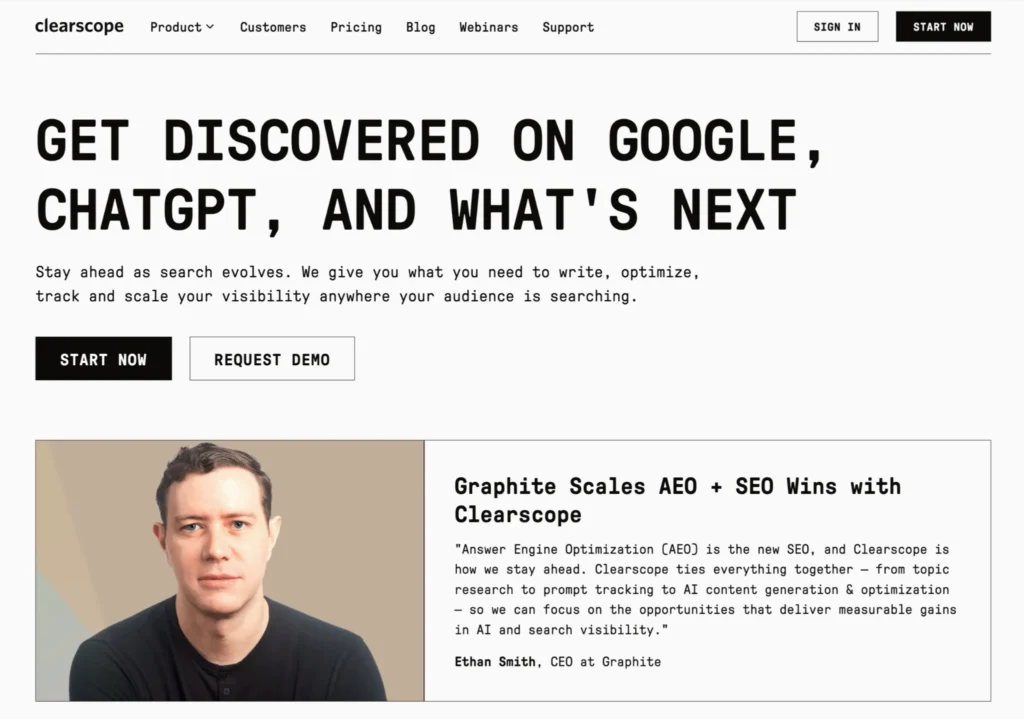
Source: Clearscope
Best for: High-quality, authority-driven content
Clearscope focuses less on “optimising” and more on getting content right. It helps you build depth, clarity, and relevance, all key signals for modern SEO and AI visibility.
This is why it’s widely used by established brands and editorial teams.
Key features:
- Semantic keyword and topic suggestions
- Content grading based on relevance
- Focus on E-E-A-T signals
- Clean, distraction-free editor
- FAQs that deal with objections, pricing, process, and timelines
Used by serious brands: Ideal if you want to build authority, not just publish content.
Frase
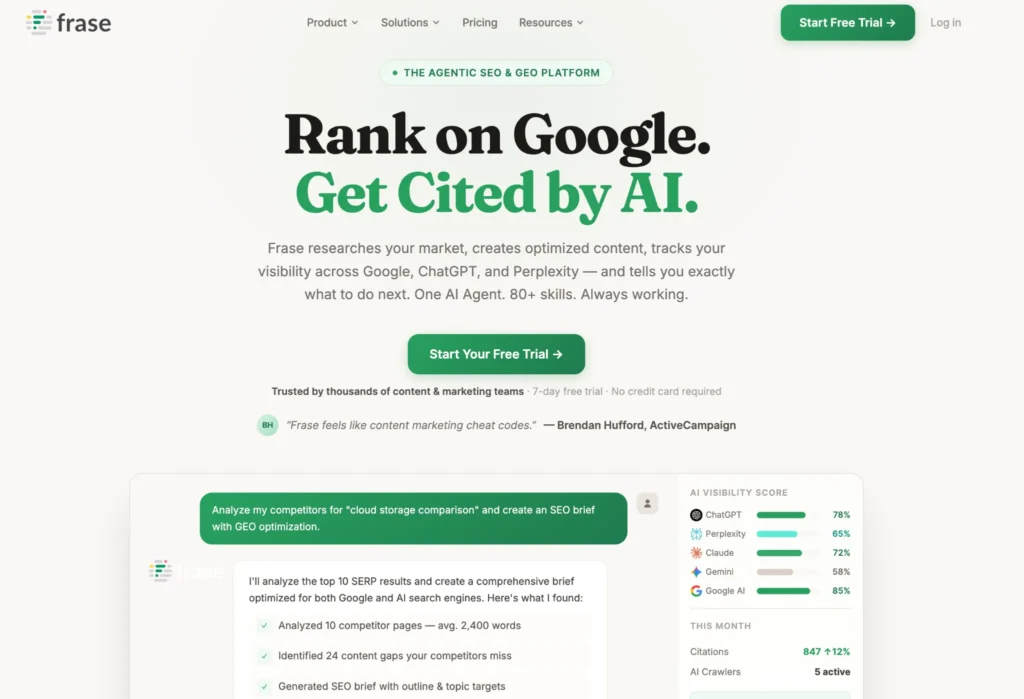
Source: Frase
Best for: Answer-based SEO
Frase is built around how people actually search — through questions. It pulls real queries from platforms like forums and search results, helping you create content that directly answers them.
This makes it especially useful for artificial intelligence search engine optimisation.
Key features:
- Extracts questions from SERPs, Reddit, Quora
- Generates content briefs quickly
- AI-assisted writing and optimisation
- Strong FAQ and snippet structuring
Perfect for AI snippets: Helps your content get picked up in featured answers and AI responses.
MarketMuse
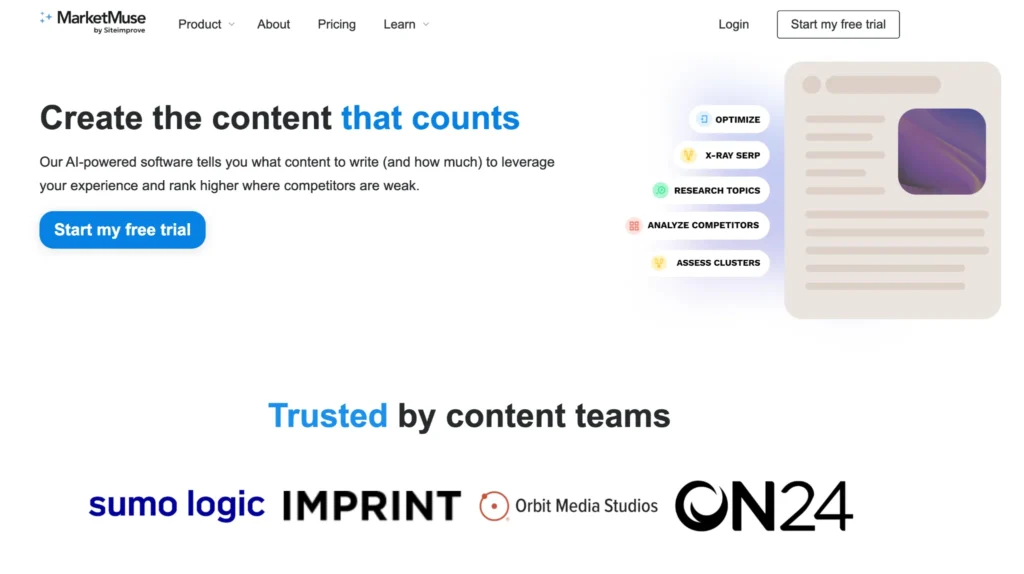
Source: MarketMuse
Best for: Building topic authority
MarketMuse takes a bigger-picture approach. Instead of focusing on one page, it helps you understand what your entire website needs to cover to become an authority in your niche.
This is critical in 2026, where depth beats volume.
Key features:
- AI-driven content clustering
- Topic authority scoring
- Content gap analysis
- Personalised content briefs
Helps dominate niches: If you want to own a topic — not just rank for it — this is the tool.
AI Content Creation (Speed + Scale)
Content is still the foundation of SEO, but how it’s created has completely changed.
Today, over 94% of marketers are already using AI in content creation. At the same time, traffic is getting harder to win, with many businesses seeing declines as users shift towards AI-generated answers.
That’s why these AI SEO tools matter — they help you create faster, but more importantly, create content that actually performs.
Jasper AI
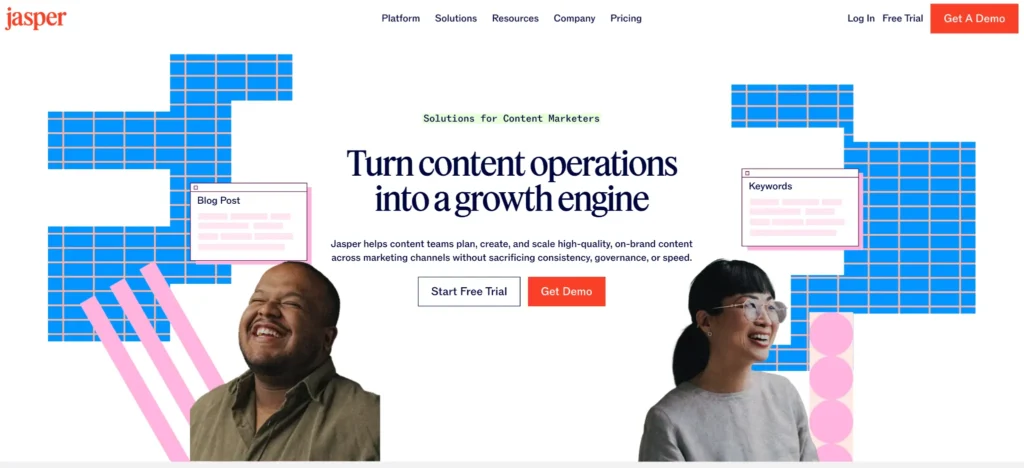
Source: Jasper
Best for: Scaling content production
Jasper is one of the most widely used SEO writing AI tools for businesses that need consistent content output. It’s not just about generating text — it’s about producing structured, SEO-ready drafts quickly.
For teams producing blogs, landing pages, or campaigns regularly, this saves serious time.
Key features:
- SEO mode for optimised content
- Integration with tools like Surfer
- Long-form content generation
- Brand voice consistency
Best for scale: Helps you produce more content without compromising structure.
Scalenut
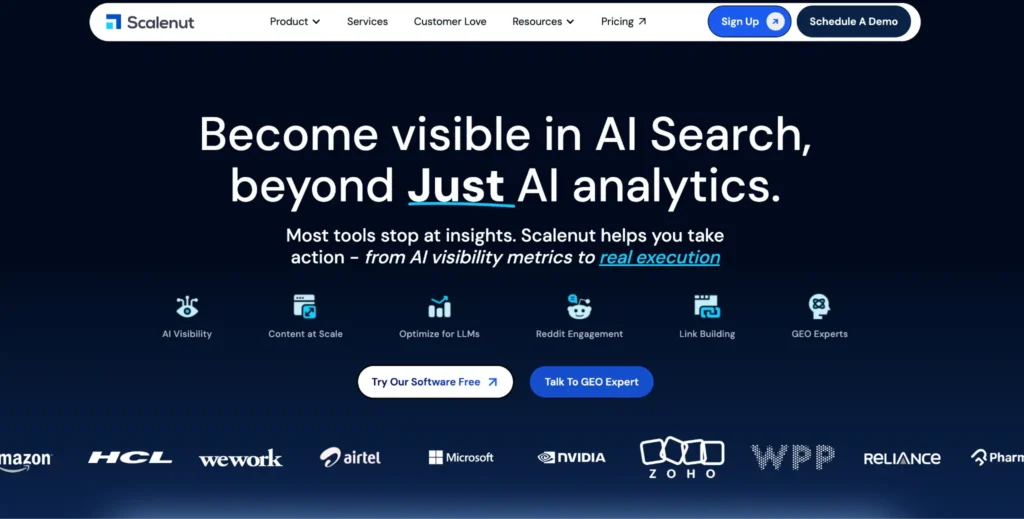
Source: Scalenut
Best for: End-to-end content workflow
Scalenut takes a more complete approach. Instead of just writing, it covers the entire process — from research to publishing.
For businesses that don’t want to juggle multiple tools, this is a strong all-in-one AI SEO software for content.
Key features:
- Research → write → optimise workflow
- Topic clustering and keyword planning
- AI writing + optimisation combined
- Built-in SEO scoring
Why it stands out: You don’t just create content — you build a structured content system.
ChatGPT
Source: ChatGPT
Best for: Strategy + workflows
This is where most businesses underestimate the power of AI.
Tools like ChatGPT are not just for writing; they’re becoming central to how artificial intelligence search engine optimisation works.
The scale tells the story: ChatGPT now has 800M+ weekly active users globally, and a significant portion of usage is tied to writing and content-related tasks.
What this really means is AI isn’t just supporting SEO anymore, it’s actively shaping how content is created, structured, and discovered.
Key features:
- Keyword clustering and topic mapping
- Content ideation and structuring
- GEO (AI visibility) optimisation
- Workflow automation and strategy building
Core tool: Used properly, it helps you build your entire SEO system, not just content.’
Technical SEO & Automation (Hidden Growth Lever)
This is the part most businesses ignore — and it’s often where the biggest gains are hiding.
Technical SEO isn’t just about “fixing errors.” It directly impacts how your site ranks, how fast it loads, and how well it converts visitors. Google has already confirmed that page experience and Core Web Vitals play a role in rankings, so performance is no longer optional.
The good news is, modern AI SEO tools make this much easier than before.
Alli AI
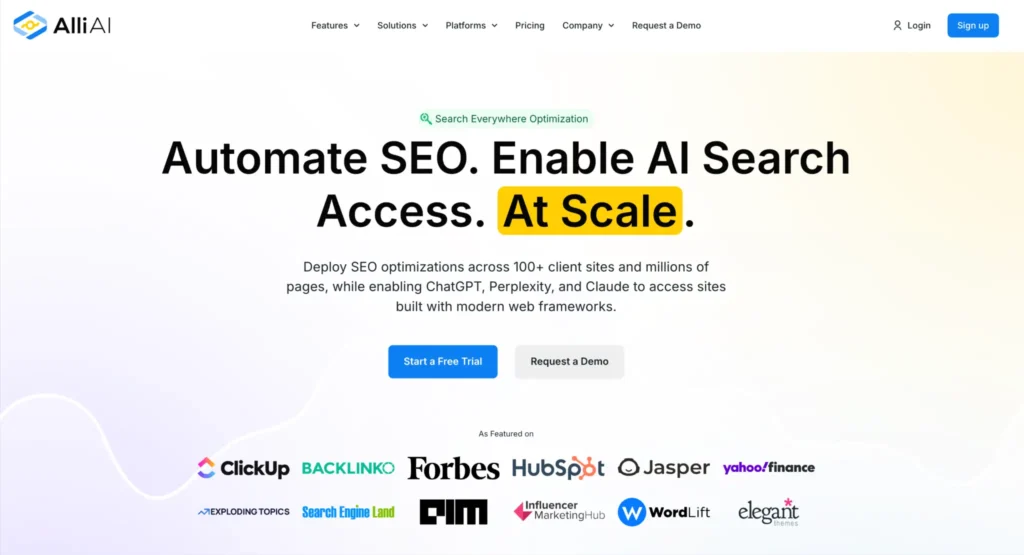
Source: Alli Al
Best for: Scaling SEO changes
If your website has dozens (or hundreds) of pages, making manual SEO updates can take forever. That’s exactly what Alli AI solves.
Instead of editing each page individually, you can roll out changes across your entire site in minutes. This makes it one of the most practical AI SEO software tools for growing businesses.
Key features:
- Bulk on-page SEO updates across pages
- Automated schema markup
- Internal linking automation
- SEO A/B testing
The real benefit here is speed. You can implement improvements quickly, test what works, and scale what delivers results.
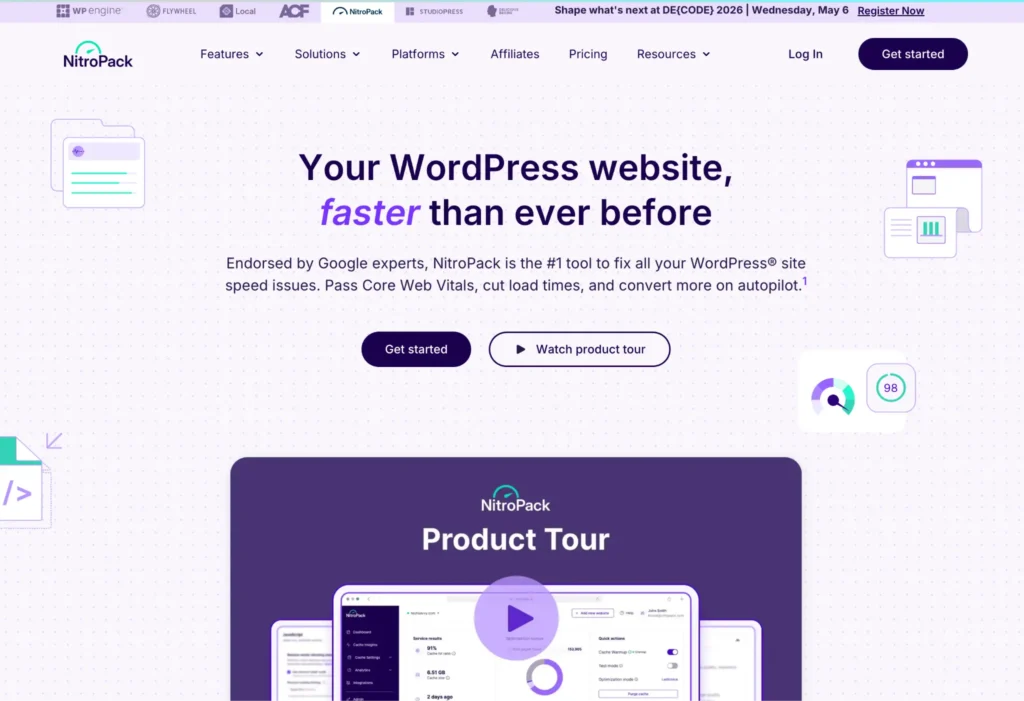
NitroPack
Source: NitroPack
Best for: Core Web Vitals & speed
A slow website doesn’t just frustrate users — it costs you leads.
Google data has consistently shown that even a small delay in load time can reduce conversions. And with Core Web Vitals now part of ranking signals, performance directly affects visibility too.
NitroPack helps you fix this without needing technical expertise.
Key features:
- Advanced caching and speed optimisation
- Core Web Vitals improvements
- Image and code optimisation
- CDN integration
Faster pages don’t just rank better — they convert better. And that’s what matters.
Structure, Links & Internal SEO
You can create great content, but if your site structure is weak, it won’t perform as well as it should.
Internal linking plays a big role in how search engines understand your website and how users navigate it. Yet, it’s one of the most overlooked areas in SEO AI tools.
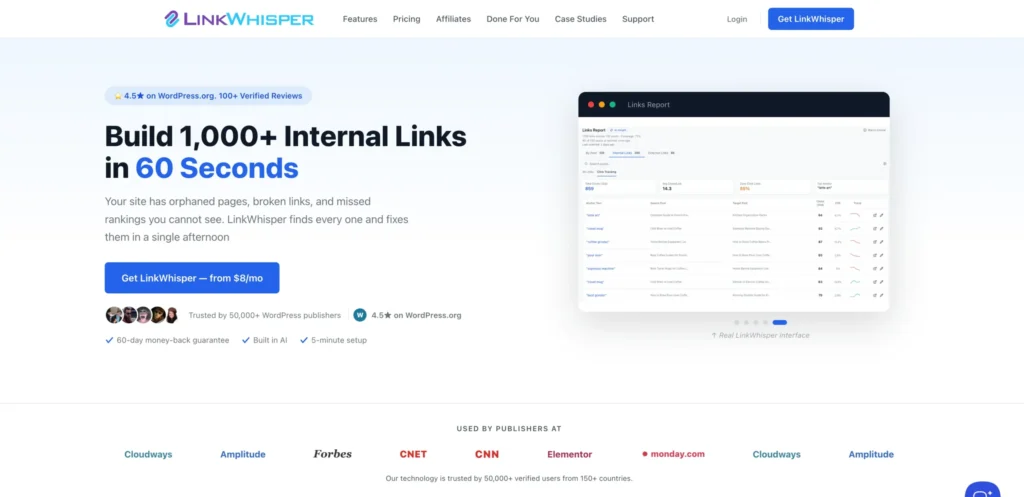
Link Whisper
Best for: Internal linking
Link Whisper focuses on a simple but powerful idea — helping you build internal links without overthinking it.
As you create content, it suggests relevant links automatically, making it easier to connect your pages and strengthen your overall site structure.
Key features:
- AI-powered internal link suggestions
- Optimised anchor text
- Link tracking and reporting
- Easy WordPress integration
Strong internal linking improves crawlability, distributes authority across pages, and helps your content rank better — without extra effort.
Structure, Links & Internal SEOGEO & AI Visibility Tools (NEW in 2026)
This is where SEO is heading — and most blogs completely miss it.
If you’ve read this far, you already understand that visibility is no longer just about rankings. It’s about whether your brand shows up inside AI-generated answers.
That’s exactly what this category focuses on.
These tools are built for GEO (Generative Engine Optimisation), helping your content get noticed, extracted, and cited by AI platforms.
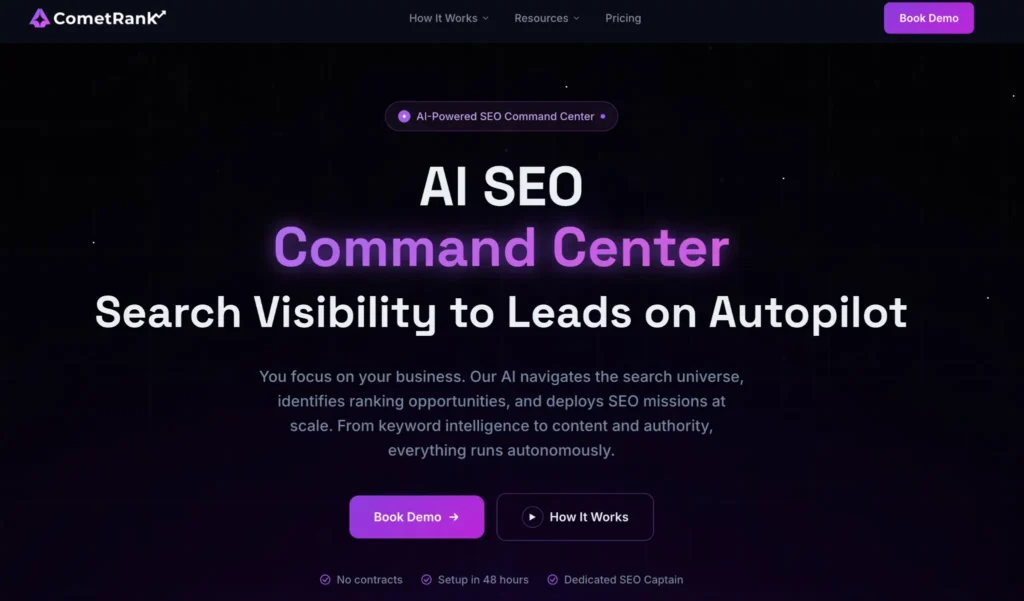
CometRank
Source: CometRank
Best for: AI citation tracking
CometRank is one of the few tools built specifically for tracking how your content performs inside AI answers.
Instead of just showing rankings, it tells you whether your content is being picked up by AI systems, and which parts of it are working.
For businesses serious about AI visibility, this is a big shift.
Key features:
- Tracks where AI pulls your content from
- Identifies which pages get cited in AI answers
- Highlights gaps in AI visibility
- Suggests improvements for better citation
The real value here is clarity. You’re not guessing anymore — you can see exactly how AI is using your content.
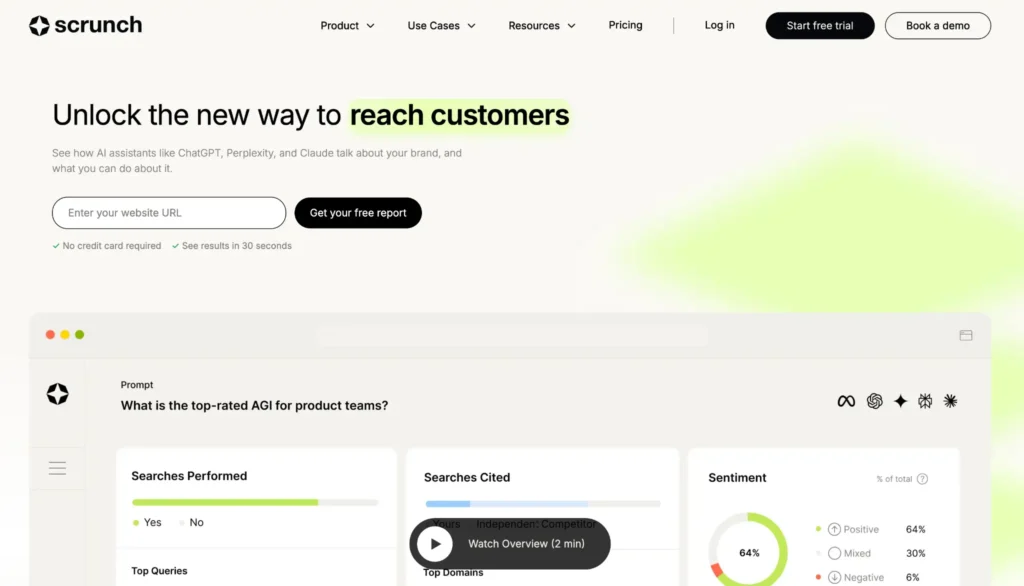
Scrunch
Source: Scrunch
Best for: Enterprise-level GEO
Scrunch is built for businesses that want to go deeper into AI search optimisation. It focuses on how AI crawlers access and understand your content.
Its AXP (Agent Experience Platform) is designed to serve AI-friendly content without affecting the user experience.
Key features:
- AI crawler optimisation
- AXP platform for AI-ready content delivery
- Advanced GEO tracking and insights
- Built for large-scale, multi-market websites
This is where things are heading. As AI search grows, tools like this will become essential for maintaining visibility at scale.
If you’re thinking long-term, this category matters the most.
Because in the coming years, businesses won’t just compete for rankings, they’ll compete to be the source AI chooses to trust.
Marketing Research & Strategy
We help you understand your market and build smart strategies to attract more customers and grow faster.
- Detailed research into your competitors, customers, and market
- Custom marketing and growth plans that drive real results
- Clear action steps to increase traffic, leads, and sales

ADWORDS ROI

Cut Ad spend

So, Which AI SEO Tool Should You Choose for Your Business?
With so many options available, the real question isn’t “which is the best AI SEO tool?”
It’s “which tool fits your business right now?”
Here’s a simple way to decide based on your goals:
- Small business / starting out → SE Ranking or SiteGuru
- Content-driven growth → Surfer SEO + Frase
- Scaling content production → Jasper AI + Scalenut
- Building authority in a niche → MarketMuse
- Full SEO strategy and growth → Semrush or Ahrefs
- AI visibility (GEO focus) → CometRank or Scrunch
The key is not to pick everything.
Pick what solves your current bottleneck, and build from there.
The Best AI SEO Stack for Businesses (Proven Setup)
Most businesses make the mistake of relying on one tool.
That rarely works.
What actually delivers results is a simple, connected system where each tool has a clear role.
Here’s a proven setup we use:
- Research → Ahrefs
- Strategy → ChatGPT
- Content creation & optimisation → Surfer SEO + Frase
- Publishing → WordPress + Rank Math
- Tracking & performance → Semrush
This approach works because each part supports the next.
You’re not just using tools randomly.
You’re building a system.
And that’s the real difference.
Digital Marketing, SEO & PPC
- SEO to boost rankings and capture high-intent, AI-driven traffic
- Performance Marketing to run ROI-focused campaigns that convert
- Content Marketing to drive clicks, earn links, and build authority
Common Mistakes Businesses Make with AI SEO Tools
Even the best AI tools for SEO won’t work if they’re used the wrong way. These are the most common mistakes we see:
- Relying only on AI writing without adding real expertise or value
- Ignoring conversion and focusing only on traffic
- Not optimising for AI search and citations (GEO)
- Using multiple tools without a clear strategy
- Chasing traffic instead of attracting qualified leads
The Future of SEO (2026–2028)
SEO is moving fast, and the direction is clear. AI Overviews and AI Mode are already reshaping search, with nearly 60% of searches now ending without a click, reducing traditional website traffic.
At the same time, brand mentions are becoming more important than backlinks, as AI engines prioritise trusted sources over just links.
Content also needs to evolve. It’s no longer just about writing for users, but structuring content so AI can easily extract and reference it. With platforms like ChatGPT and Google Gemini being used by hundreds of millions globally, visibility is shifting beyond search results.
Search itself is becoming more conversational, with users asking full questions instead of typing keywords.
For businesses, this means one thing: adapting early is no longer optional.
Marketing Research & Strategy
We help you understand your market and build smart strategies to attract more customers and grow faster.
- Detailed research into your competitors, customers, and market
- Custom marketing and growth plans that drive real results
- Clear action steps to increase traffic, leads, and sales
ADWORDS ROI
Cut Ad spend
From Traffic to Revenue: Let’s Fix Your SEO
If you’ve read this far, you already understand the gap. Most businesses are doing SEO, but very few are turning it into consistent leads.
That’s exactly what we focus on.
Instead of chasing rankings, we look at your full funnel, where you’re losing visibility, where traffic is dropping off, and what’s stopping visitors from converting. From there, we give you a clear, practical plan to fix it.
In a free 1:1 strategy call, we’ll audit your website, identify missed opportunities, and show you how to turn your SEO into a lead-generating system.
No generic advice, just actionable insights tailored to your business.
Frequently Asked Questions
What is GEO in SEO?
GEO (Generative Engine Optimisation) is the next stage of SEO. Instead of only optimising your content to rank on Google, you optimise it to appear inside AI-generated answers on platforms like ChatGPT, Google Gemini, and Perplexity AI.
In simple terms, it’s about making your content easy for AI to understand, extract, and cite — so your business gets visibility even when users don’t click through to websites.
How do AI tools for SEO help generate leads (not just traffic)?
Modern AI tools for SEO are built around intent, not just keywords. They help you understand what your audience is actually searching for, structure your content properly, and guide users towards taking action.
So instead of bringing in random traffic, you attract the right people — those who are more likely to enquire, book, or buy.
Which AI tool is best for small businesses?
For most small businesses, the goal is simplicity and clarity. Tools like SE Ranking or SiteGuru work well because they provide essential features without overwhelming you with complexity.
They help you track performance, identify issues, and improve your website step by step — which is exactly what most businesses need at the start.
What is the best AI SEO stack?
There’s no single tool that does everything perfectly. What works better is a simple system where each tool plays a specific role.
For example, you might use Ahrefs for research, ChatGPT for planning and strategy, Surfer SEO and Frase for content, and Semrush for tracking performance.
This kind of setup works because everything is connected — you’re not just using tools, you’re building a system.
Can AI replace SEO experts?
AI has made SEO faster and more efficient, but it hasn’t replaced expertise.
Tools can analyse data and generate content, but they don’t understand your business, your audience, or your positioning the way a human does. The best results come when AI is used as a support system — not as a replacement for strategy.
How do AI-driven SEO tools help in optimisation?
AI-driven tools process large amounts of data quickly and turn it into clear recommendations. They can identify gaps in your content, suggest improvements, and highlight opportunities you might miss manually.
This makes optimisation more structured and less guesswork-driven, especially when you’re scaling your SEO efforts.
How to use SEO tools effectively?
The key is not to use more tools, but to use them with purpose.
Start by understanding your audience and what they’re searching for. Then use tools to plan content, optimise your pages, and track results. Over time, refine what works and focus more on what drives enquiries.
Consistency matters more than complexity.
How do I do SEO for my website?
SEO comes down to a few core things done well.
You need content that answers real questions, a website that’s fast and easy to use, and enough authority for search engines to trust you. Alongside that, you need to track performance and keep improving over time.
It’s not about quick wins, it’s about building visibility and trust consistently.