
Why Real Estate Google Ads Costs Are Rising (And What Actually Reduces CPL)


Real Estate Google Ads Costs Are Rising — Here’s Why & How to Fix It
Table of Contents
Serious about growing your business? Let’s plan exactly how to get you more leads, sales, and results—faster.
Google Ads has long been a reliable channel for real estate lead generation.
Estate agents, realtors, and investors still use Google Ads for real estate to capture demand at the moment people search.
What’s changed is the cost.
Across competitive markets, real estate Google Ads CPCs have risen sharply in recent years, with industry benchmarks showing year-on-year increases of 25–35% in many real estate segments.
But higher click prices are only part of the story.
Cost per lead has increased even faster — not because demand has dropped, but because conversion efficiency has declined.
Today, paid search real estate Google Ads campaigns often see cost per lead in the $50–$150 range, with recent benchmarks pointing to average CPLs around $95–$100 in competitive markets, depending on CPC and conversion rates.
Many advertisers are spending more while seeing flat or declining lead quality.
This isn’t happening simply because more competitors are bidding.
It’s happening because the platform itself has changed.
This post breaks down why real estate Google Ads costs are rising, what’s driving the shift, and what you can do to actually reduce CPL without cutting lead volume.
Digital Marketing, SEO & PPC
- SEO to boost rankings and capture high-intent, AI-driven traffic
- Performance Marketing to run ROI-focused campaigns that convert
- Content Marketing to drive clicks, earn links, and build authority

What Changed in Google Ads for Real Estate
Google Ads is no longer a keyword-first platform.
In reality, it hasn’t been for a while.
Over the past few years, Google has shifted heavily toward automation.
Today, most Google Ads spend runs through automated bidding systems, where algorithms decide how aggressively to bid and who should see ads.
Source: Search Engine Land
Manual control still exists, but in competitive spaces like real estate, it actually carries far less weight than it used to.
Keywords now act more like signals than strict triggers.
Exact match isn’t truly exact anymore, and broad match expands far beyond the original search term.
Google interprets intent using behaviour, context, and historical data, not just keywords. As a result, advertisers often have less visibility into why ads are being shown in the first place.
Moreover, Google now spreads traffic across multiple formats by default.
Search, Performance Max, and Local Service Ads frequently compete for the same audience, sometimes inside the same account.
This internal competition doesn’t create more demand — it simply pushes auction prices higher.
Manual CPC has also lost much of its effectiveness.
In high-demand real estate auctions, automated strategies tend to outbid manual setups, especially when conversion data is incomplete or delayed.
So while bids may look controlled on the surface, the auction itself is no longer responding the way it once did.
All this means that campaign structures which worked well before 2023 now deliver weaker results at higher costs.
Not because they’re poorly built, but because they were designed for a version of Google Ads that no longer exists.
Marketing Research & Strategy
We help you understand your market and build smart strategies to attract more customers and grow faster.
- Detailed research into your competitors, customers, and market
- Custom marketing and growth plans that drive real results
- Clear action steps to increase traffic, leads, and sales


ADWORDS ROI

Cut Ad spend

Why Real Estate Google Ads Costs Continue to Increase
Here are the top reasons why ads are getting more expensive today:
1. Auction Saturation in Core Real Estate Keywords
Competition in core real estate keywords has intensified sharply.
Searches like sell house, estate agent, and property investment now attract bids from local agents, national brands, listing portals, developers, and institutional buyers at the same time.
Moreover, Google doesn’t separate these players cleanly.
Different advertiser types, and even different campaign types from the same account, often compete inside the same auction.
As a result, increasing the budget no longer expands reach in a meaningful way.
In many accounts, higher spend simply raises CPC without improving impression share. Loss of visibility is now more often caused by rank, not budget limits.
2. Smart Bidding Performance Without Strong Signals
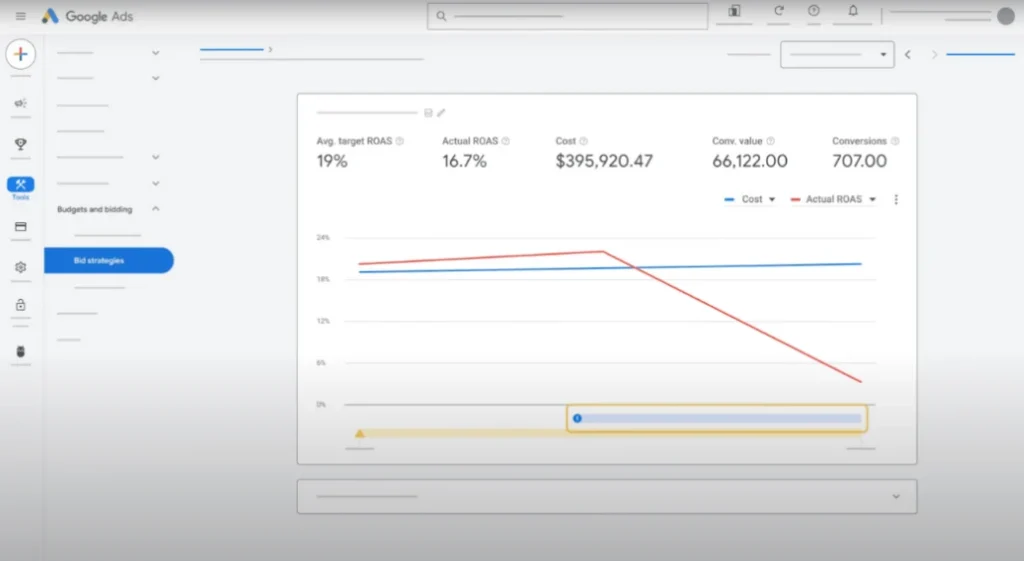
Smart Bidding only works when it has enough data to learn from.
Google’s automated bidding systems rely on conversion signals to adjust bids and predict outcomes. In practice, this means campaigns need sufficient conversion volume over time before performance stabilises.
Source: Search Engine Land
Industry guidance and Google documentation both suggest that Smart Bidding performs more reliably once a campaign generates around 30–50 conversions per month.
With roughly 50 conversion events often needed to move out of the learning phase and optimise consistently.`
Many real estate campaigns never reach this threshold.
As a result, they remain stuck in learning mode. During this phase, Google explores aggressively, testing bids and placements to gather data. This often leads to higher costs without clear efficiency gains.
When conversion data is inconsistent, delayed, or incomplete, the system prioritises data collection over cost control.
In these cases, cost per lead tends to rise even though overall demand hasn’t changed.
Digital Marketing, SEO & PPC
- SEO to boost rankings and capture high-intent, AI-driven traffic
- Performance Marketing to run ROI-focused campaigns that convert
- Content Marketing to drive clicks, earn links, and build authority
3. Quality Score Degradation in Real Estate Accounts
Quality Score still matters in Google Ads — it influences how much you pay for clicks and where your ads appear.
A higher Quality Score generally leads to lower CPC and better ad placements because Google rewards relevance and user experience, while a lower score tends to increase costs and reduce visibility.
Quality Score is determined by expected click-through rate, ad relevance, and landing page experience, and all three are directly tied to how well your ads and landing pages match the searcher’s intent.
When campaigns send traffic to generic landing pages or use broad, off-target messaging, relevance signals weaken.
That typically results in lower expected CTR, poorer landing page experience, and lower ad relevance — the core components Google uses to evaluate Quality Score.
Lower Quality Score doesn’t just raise CPC; it also reduces impression share and ad rank, making it harder for your ads to compete efficiently in auctions.
4. Inadequate Conversion Signal Quality
Not all leads are equal, but Google treats them the same unless you give it better signals.
Advertisers often track basic actions — like every form fill or phone call — as conversions without distinguishing quality.
When Google’s Smart Bidding only sees broad conversion data, it optimises for volume, not lead quality, which can push costs up without improving business outcomes.
Responding quickly to leads matters.
Research shows that contacting leads within five minutes can make you up to 21× more likely to qualify them compared with waiting longer, and conversion odds drop rapidly as response time increases.
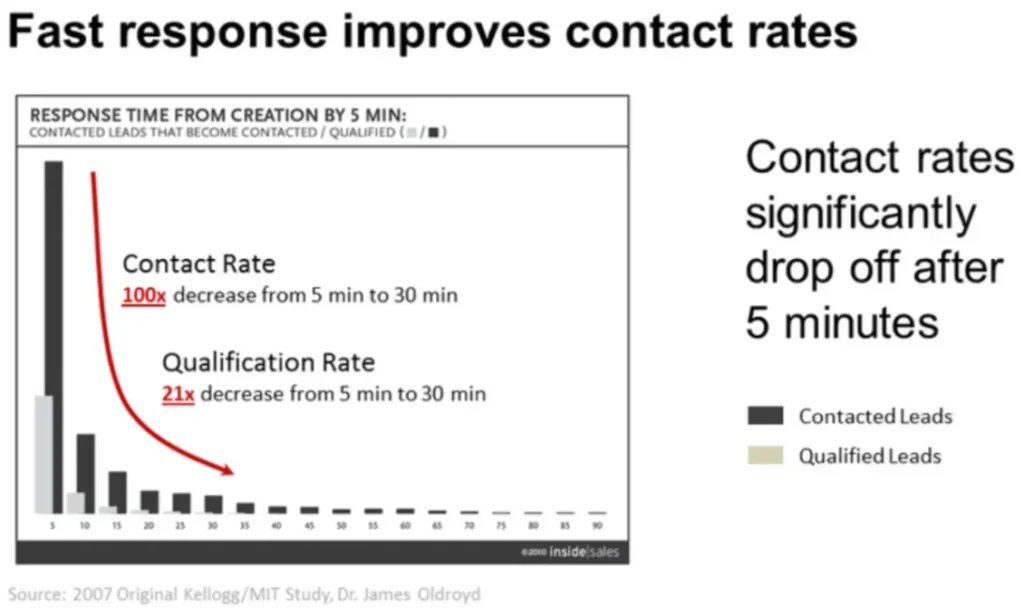
(here ‘s a graph from original research from Dr. James Oldroyd and InsideSales.com.)
However, many businesses do not follow up fast enough: average lead response times across industries can be measured in hours rather than minutes, which harms conversion efficiency.
At the same time, most advertisers don’t send offline conversion data — such as closed deals, booked appointments, or qualified lead outcomes — back to Google Ads.
When this critical feedback isn’t included, Smart Bidding has an incomplete picture of which leads actually matter, and it continues to optimise toward generic conversions rather than valuable outcomes.
Marketing Research & Strategy
We help you understand your market and build smart strategies to attract more customers and grow faster.
- Detailed research into your competitors, customers, and market
- Custom marketing and growth plans that drive real results
- Clear action steps to increase traffic, leads, and sales
ADWORDS ROI
Cut Ad spend
What Actually Reduces Cost Per Lead in Real Estate Campaigns
1. Intent Segmentation Before Budget Allocation
Buyers, sellers, investors, and renters do not search with the same mindset.
They use different language, have different levels of urgency, and expect different outcomes.
When these intent types are bundled into a single campaign, relevance drops quickly. Ads become vague. Landing pages try to speak to everyone. Conversion rates fall, and cost per lead rises as a result.
Separating campaigns by intent changes this dynamic.
When keywords, ad messaging, and landing pages are aligned to a single intent, relevance improves across the entire journey. Click-through rates improve, landing page experience strengthens, and bidding becomes more efficient.
In practice, intent-segmented campaign structures often deliver meaningfully lower CPL and more stable performance, even without increasing spend.
2. Signal Quality Over Signal Quantity
More data does not automatically lead to better optimisation.
What matters is whether the data reflects real outcomes.
Smart Bidding relies on conversion signals to learn. When those signals are shallow or inconsistent, optimisation suffers.
Micro conversions help guide early learning.
Macro conversions define what a qualified lead actually looks like.
Offline conversion imports are what close the loop.
They tell Google which enquiries turned into real conversations, appointments, or deals. Without that feedback, the system can only optimise for what it can see — usually form fills or calls — regardless of quality.
Accounts that use layered conversion signals tend to stabilise faster. In many cases, improving signal quality reduces effective CPL even if total lead volume doesn’t change significantly.
3. Landing Page Alignment With Search Intent
Landing pages are where most wasted spend hides.
Especially in real estate.
A user searching with urgency expects a page that speaks directly to that urgency. When they land on a generic page instead, conversion rates drop sharply.
Google evaluates landing page experience as part of ad relevance and Quality Score. Pages that closely match the search intent tend to perform better on both conversion rate and cost efficiency, while broad pages weaken relevance signals.
This is why sending Google Ads traffic to homepages or generic listings pages underperforms in most accounts.
Clear alignment between keyword, ad copy, and landing page improves expected click-through rate, landing page experience, and Quality Score. As a result, bounce rates fall and cost per lead becomes easier to control.
Trust signals also need to match intent. A seller-focused search requires different proof points than a buyer or investor search.
Simply having trust elements on the page isn’t enough if they don’t align with why the user clicked in the first place.
Digital Marketing, SEO & PPC
- SEO to boost rankings and capture high-intent, AI-driven traffic
- Performance Marketing to run ROI-focused campaigns that convert
- Content Marketing to drive clicks, earn links, and build authority
4. Refined Keyword Architecture
Unstructured keyword sets quietly inflate costs over time.
They pull in research queries, career searches, and low-intent traffic that looks relevant on the surface but rarely converts.
When transactional, research, and investor keywords are mixed together, bidding becomes inefficient and conversion data loses clarity. Smart Bidding struggles to optimise when fundamentally different intent types are treated the same.
Separating keyword groups by intent restores control.
Negative keywords then act as an active cost-control mechanism rather than a one-time cleanup task.
Terms like jobs, career, course, license, training, free, and DIY are still missed in many real estate accounts, particularly as broad match and automation expand reach.
Regular keyword pruning prevents slow, silent CPL inflation that often goes unnoticed until costs spike.
5. Strategic Use of Performance Max and Local Service Ads
Local Service Ads can work well for seller-focused local agents.
In many markets, they deliver relatively predictable lead volume, often at lower CPL than standard Search campaigns, particularly where competition is localised and service areas are clearly defined.
However, performance varies significantly by location and category. Lead costs depend heavily on competition, proximity, and verification status, and results are not uniform across markets.
Performance Max is more conditional.
When conversion data is strong and clearly defined, Performance Max can be efficient. But when signals are weak or inconsistent, it often prioritises reach and exploration. In those cases, CPC may appear lower while CPL increases due to poorer lead quality.
Because Performance Max distributes spend across multiple placements automatically, inefficient signal input can be amplified quickly.
A controlled testing approach is safer.
Allocating a limited portion of the budget — typically around 10–20% — allows Performance Max or Local Service Ads to be evaluated properly without putting core Search-driven lead flow at risk.
Cost Expectations by Real Estate Vertical
Cost per lead in real estate varies widely depending on who you’re targeting, how competitive the market is, and how buyers actually make decisions in that segment.
Local agents and estate agents typically see the most stable performance from Google Ads, especially when using Local Service Ads and tightly geo-targeted Search campaigns.
Seller intent is clearer, competition is localised, and conversion paths are shorter.
As a result, CPLs in this segment tend to sit toward the lower end of the ranges discussed earlier, assuming strong follow-up and clean tracking.
Investor-focused campaigns operate in a very different environment. Competition is often national rather than local, search intent is broader, and decision cycles are longer.
For Google Ads targeting real estate investors, CPLs are commonly moderate to high within the overall $50–$150 range, with performance needing to be evaluated against deal size and lifetime value rather than raw lead volume.
Developers and new construction advertisers face the most pressure. Competition is intense, buyer journeys are long, and conversion rates are naturally lower.
In competitive urban markets, CPLs in this segment often land toward the upper end of the same range, reflecting longer research phases and higher acquisition friction.
Because of this, benchmarks only make sense in context.
Comparing CPL across different real estate business models without accounting for intent clarity, sales cycle length, and deal value leads to misleading conclusions and poor optimisation decisions.
When Google Ads Are Worth Running for Real Estate
Google Ads works best when it’s supported by strong execution outside the platform.
Fast lead response is critical. Leads contacted within five minutes are significantly more likely to convert, yet delays remain common in many real estate businesses.
Offline conversion tracking also makes a measurable difference. Feeding outcomes back into Google improves bidding accuracy and helps Smart Bidding optimise for real results, not just form submissions.
Advertisers with a clear understanding of lead-to-close metrics consistently outperform those focused only on CPL. Knowing what a lead is worth changes how campaigns are structured and evaluated.
In practice, Google Ads rewards structured systems, not higher budgets.
When intent, signals, follow-up, and tracking are aligned, the channel remains viable. When they aren’t, rising spending simply amplifies inefficiency.
Diagnostic Checklist for High CPL
If your cost per lead keeps rising, check the following:
- Campaigns are segmented by clear intent (buyers, sellers, investors), not grouped together
- Keywords, ads, and landing pages are aligned to the same intent
- Traffic is sent to dedicated landing pages, not homepages or generic listings
- Conversions reflect qualified leads, not every form fill or call
- Offline outcomes (qualified leads or deals) are fed back into Google
- Search, Performance Max, and Local Service Ads are not competing internally
- Negative keywords block irrelevant searches that never convert
- Each campaign generates enough data to exit learning mode
- Leads are contacted within five minutes
- Cost per closed deal is tracked alongside CPL
When several of these elements are missing, rising CPL is usually the result of structural problems rather than bid settings or spend.
Final Thoughts
Real estate Google Ads still work for advertisers who adapt to how auctions, bidding, and signals now operate.
The accounts struggling most are often using structures that were effective years ago but no longer fit the way Google Ads functions today.
Lower CPL doesn’t come from bid tweaks or higher budgets.
It comes from structural alignment, matching intent, keywords, messaging, landing pages, conversion signals, and follow-up.
The advertisers are consistently reducing CPL focus on signal quality and campaign architecture, not on spending more to compensate for inefficiencies.
Want Google Ads to Work for You — Not Waste Your Budget?
If you’re running Google Ads but costs keep rising without better results, you can book a free strategy session with our real estate marketing experts to review what’s happening inside your account.
They can identify where CPL is leaking as well as suggest to you what changes would actually improve performance.
This is no obligation. Just to give you clarity on whether Google Ads can work better for your property business, and how to stop wasting budget if it isn’t.
Frequently Asked Questions
Are Google Ads worth it for real estate agents in 2026?
Yes, they are worth it, but only if they’re run properly.
Google Ads still capture high-intent searches, especially from sellers and motivated buyers. What’s changed is that mistakes are now expensive.
Without a clear structure, strong tracking, and fast follow-up, costs rise quickly without better outcomes.
What is a good cost per lead for real estate Google Ads?
There isn’t a single benchmark that applies to everyone.
CPL depends on location, competition, and the type of real estate business.
Local agents often see lower CPLs than investors or developers, who typically face longer sales cycles. The more useful measure is whether the CPL makes sense relative to your close rate and deal value.
How should I run Ads for my real estate business?
Start with intent, not volume.
You should separate your target audience, whether they’re buyers, sellers, or investors, into different campaigns, each with its own keywords, messaging, and landing pages.
Track qualified enquiries, not just form fills, and follow up quickly to maintain performance.
How can I reduce CPL without losing lead volume?
Most CPL problems come from wasted spend, not lack of demand.
Improving relevance between keywords, ads, and landing pages, blocking irrelevant searches, and feeding better conversion signals back into Google usually lowers CPL without reducing lead flow.
Do Local Service Ads work better than Google Search for estate agents?
Sometimes. Local Service Ads tend to work well for seller-focused agents in specific areas. Search ads are more flexible and often better for buyers or investors.
In many cases, using both together produces more stable results than relying on one channel alone.
Why do my Google Ads get clicks but no quality leads?
This is usually an intent issue. Ads may be showing for searches that look relevant but don’t reflect real buyer or seller intent.
Generic landing pages, weak negative keyword management, or treating every enquiry as a conversion can all lead to clicks without meaningful leads.
How long does it take for Google Ads to work in real estate?
Leads can come in quickly, but consistent performance takes longer.
Most campaigns need several weeks of data to stabilise, especially when automated bidding is used. Results improve faster when campaigns are structured correctly from the start and supported by good tracking and follow-up.


