
How to Increase Real Estate Sales Without Spending More on Ads


How to Fix Your Real Estate Lead Leakage
Table of Contents
Serious about growing your business? Let’s plan exactly how to get you more leads, sales, and results—faster.
10 Proven Strategies to Use in 2026
Real estate ads are getting more expensive, and for most agents, they’re not delivering better results.
Google PPC for realtors and Facebook ads for agents now cost 20–35% more per click, yet enquiries are dropping, and competition is rising.
The problem usually isn’t real estate lead generation. It’s what happens after the lead comes in.
Over 70% of leads never receive proper follow-up, and the average real estate website still converts at only 2–3%.
That means most of the money spent on real estate advertising is quietly wasted.
More property ads won’t fix slow replies, weak trust, or inconsistent follow-up.
Sales grow when you fix what happens after the enquiry, not when you spend more.
And this guide breaks down 10 practical ways to increase real estate sales without spending more on paid ads.
These are the same principles we use at Credofy to help real estate agents and property businesses turn existing property leads into predictable revenue, without relying on bigger Ad budgets.
Marketing Research & Strategy
We help you understand your market and build smart strategies to attract more customers and grow faster.
- Detailed research into your competitors, customers, and market
- Custom marketing and growth plans that drive real results
- Clear action steps to increase traffic, leads, and sales

ADWORDS ROI

Cut Ad spend

If you’re serious about getting more deals from the leads you already have, this is where to start.
10 Ways to Increase Property Sales Without More Ads
1. Activate Your Sphere of Influence
If you want to increase real estate sales without more ads, start here. 60–75% of real estate transactions come from referrals and repeat clients.
Yet most agents contact their database fewer than six times per year. That’s why many keep chasing new real estate leads instead of closing warm ones.
We saw this clearly with a UK real estate client we worked with.
They were spending over £300,000 per year on real estate ads and pushing us to increase the budget because leads were getting more expensive. But when we audited their CRM, the real issue came up.
More than 8,000 leads hadn’t been followed up on more than three times in the past month.
Industry data shows most leads need 8–10 contact attempts before they’re truly unresponsive. These leads weren’t dead. They were ignored.
The moment the team reactivated those 8,000 leads with structured follow-up calls, the results were immediate.
Within 30 days, they generated 200+ warm conversations and 27 new clients closed, without increasing ad spend.
Your past clients already trust you.
They don’t need selling. They need consistency. Just a regular, useful contact so people remember you when a referral opportunity comes up.
Effective agents use a simple mix:
- Short market update emails
- Quick check-in texts
- Occasional calls
- Handwritten notes or small pop-bys
You don’t need to do all of it. You just need to show up regularly.
Small client events work well, too. Casual brunches. Happy hours. Appreciation nights.
They create real connections and generate referrals without asking for them.
At Credofy, we help agents systemise this so it runs automatically. The result is more real estate clients from people who already know you, without relying on real estate advertising.
2. Attract Clients With Educational Short-Form Video
Short-form video is one of the most effective ways to get real estate clients right now, without paid ads.
Educational content is outperforming listing promotions across platforms.
Trust-building videos attract higher-intent realtor leads than polished property tours, especially for agents trying to stand out.
The shift is simple: teach instead of sell.

Source: Freepik
High-performing videos focus on:
- Common buyer or seller mistakes
- Local pricing trends
- Neighbourhood changes
- What sellers should know before listing
This positions you as helpful, not sales-driven.
Behind-the-scenes content works especially well. Pricing a home. Preparing a listing. Explaining a deal. It shows real work and builds trust fast.
Each video should lead somewhere:
- “DM me for the report”
- “Comment ‘guide’”
- “Link in bio for details”
That’s how video turns into real estate lead generation.
We saw this extend beyond lead generation with one of our real estate clients working with property investors.
Their show-up rate for investor calls was consistently low, even though interest was strong.
Instead of adding more reminders or ads, we advised sending short, personalised WhatsApp messages about one hour before the call. No selling—just context and value.
The result:
- Show-up rate increased by 64%
- Revenue grew by 23% over the year
Same leads. Same audience. Better communication.
Used correctly, short-form content becomes one of the best ways to get new clients in real estate without Facebook ads or Google PPC for realtors.
And once those leads come in, response speed and follow-up decide whether they convert — which is exactly what we fix next.
3. Win More Deals by Responding Faster Than Other Agents
Speed is one of the biggest advantages in real estate, and most agents don’t use it.
Responding within 5 minutes makes you up to 21× more likely to qualify a lead than responding thirty minutes later.
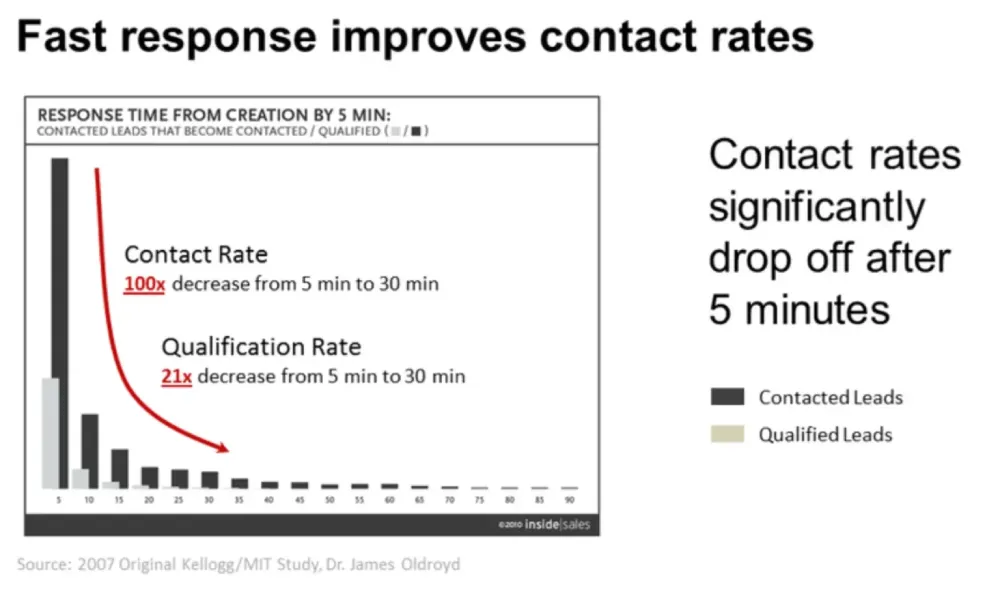
(here‘s a graph from original research from Dr. James Oldroyd and InsideSales.com.)
Yet the average response time across the industry is still measured in hours.
By then, most prospects have already moved on. This is why real estate ads often feel ineffective.
Fast responses do three things.
They acknowledge the enquiry while intent is high, they build trust before competitors reply, and they increase the chance of booking an appointment quickly.
The first response doesn’t need to sell. It just needs to be instant and clear.
A short SMS or email that confirms the enquiry and explains what happens next.
Speed alone isn’t enough. Most real estate sales require five or more follow-ups, yet many agents stop after one or two.
Without a simple structure, even strong property leads disappear.
A basic sequence works best: an instant reply, a same-day value message, a next-day check-in, then light follow-ups over the next one to two weeks.
Each touch should add value.
We saw this challenge clearly with one of our real estate clients who had a small sales team of five people.
They wanted faster response times, but it wasn’t realistic. If all five agents were on 30-minute Zoom calls with warm prospects, new leads would sit untouched.
Instead of adding more staff, we implemented an AI agent.
The moment a lead filled out a form, the AI called them within 10 seconds, qualified the enquiry, and booked a meeting based on real-time sales team availability.
No delays. No missed opportunities.
The result was an increase of 37% in booked appointments from the same real estate advertising spend, without increasing the budget.
At Credofy, this is how we help agents respond instantly and follow up consistently, even with lean teams.
If you want an automated system that handles every lead from first interaction to final close, book a free 1:1 call with our team.
Digital Marketing, SEO & PPC
- SEO to boost rankings and capture high-intent, AI-driven traffic
- Performance Marketing to run ROI-focused campaigns that convert
- Content Marketing to drive clicks, earn links, and build authority
4. Reactivate Cold Leads Instead of Buying New Ones
Most cold leads aren’t bad leads. They’re just early.
People usually stop responding because timing changes, not because interest disappears.
That’s why buying more real estate leads often feels expensive and unproductive. Reactivating old leads is one of the simplest ways to increase real estate sales without more ads.
A proven example is the nine-word reactivation message:
“Are you still looking to buy or sell this year?”
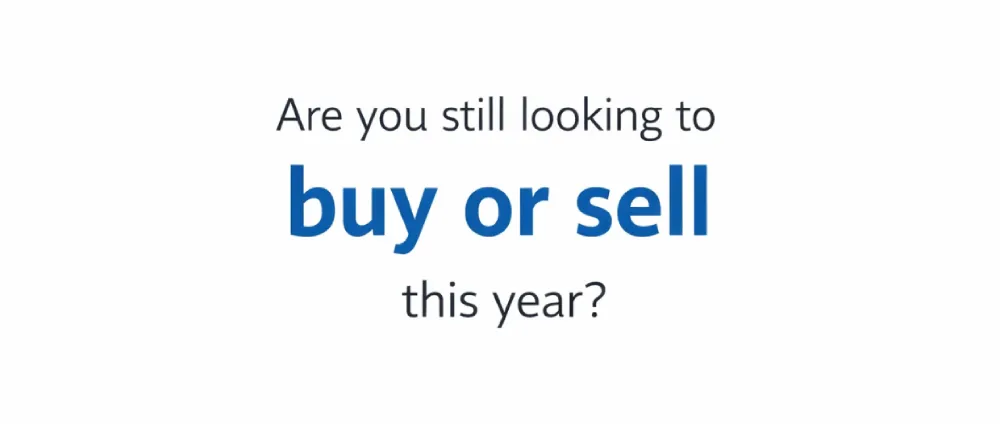
It works because it’s neutral and easy to reply to.
Segmentation makes this even more effective. Group leads by age, buyer or seller type, and past engagement. Then reach out with a clear reason to respond.
We saw this work at scale with one of our real estate clients.
They had a database of around 72,000 leads collected over five years. Instead of running more property ads, they sent a single reactivation email offering a free furniture pack as a Christmas offer.
That one campaign generated 57 closed deals in a single month, purely from cold leads that were already in their CRM.
Beyond offers, send short, value-first updates such as pricing changes, market snapshots, or local updates.
Track replies. The leads that respond are your warmest opportunities.
Reactivating old realtor leads costs nothing and usually converts faster than starting from scratch.
5. Optimise Your Website & Landing Pages to Increase Enquiries (CRO)
Your website is often where real estate leads decide whether to trust you or leave.
Improving conversion rate optimisation can lift enquiries by 20–50% without adding traffic.
Yet most real estate websites still convert at just 2–3%. That’s why many agents say, “I’m getting leads, but no showings.” The issue is rarely traffic.
It’s weak trust signals and unclear messaging.
Before buyers or sellers enquire, they look for a few specific things:
- Proof you’re active and credible, like reviews, testimonials, and recent sales
- Local market insight that shows you know their area
- A clear reason to choose you, not generic claims
If those aren’t obvious within seconds, people hesitate.
A few high-impact changes usually make the biggest difference:
- Faster load speed, especially on mobile
- Clear, action-focused CTAs like “Book a Call” or “Get a Valuation”
- Live chat or a simple chatbot to capture intent instantly
- Neighbourhood-specific pages instead of broad, generic ones
These fixes don’t require redesigning everything.
They remove friction and make it easier for real estate clients to take the next step.
At Credofy, this is often where we see the fastest gains. Fixing CRO alone can turn the same traffic into significantly more enquiries, without spending more on real estate ads.
Must Read: The Complete Guide to Building High-Converting Landing Pages in 2026
6. Rank for “Near Me” Searches With Google Business Profile
Google Business Profile is one of the highest-intent sources of real estate leads, and most agents underuse it.
People searching “estate agent near me” or “property valuation near me” are already close to action. Showing up there often beats paid listings.
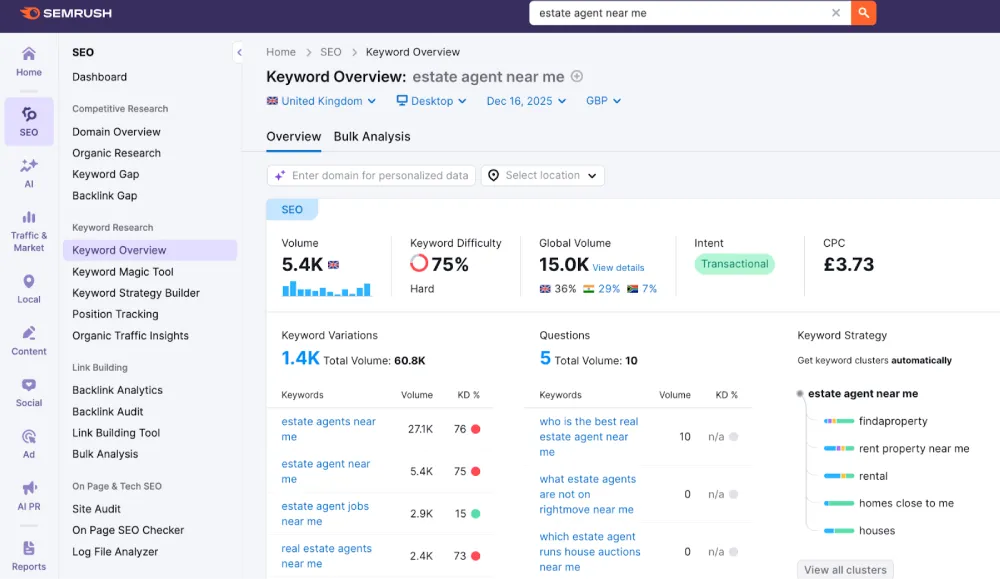
Source: Semrush
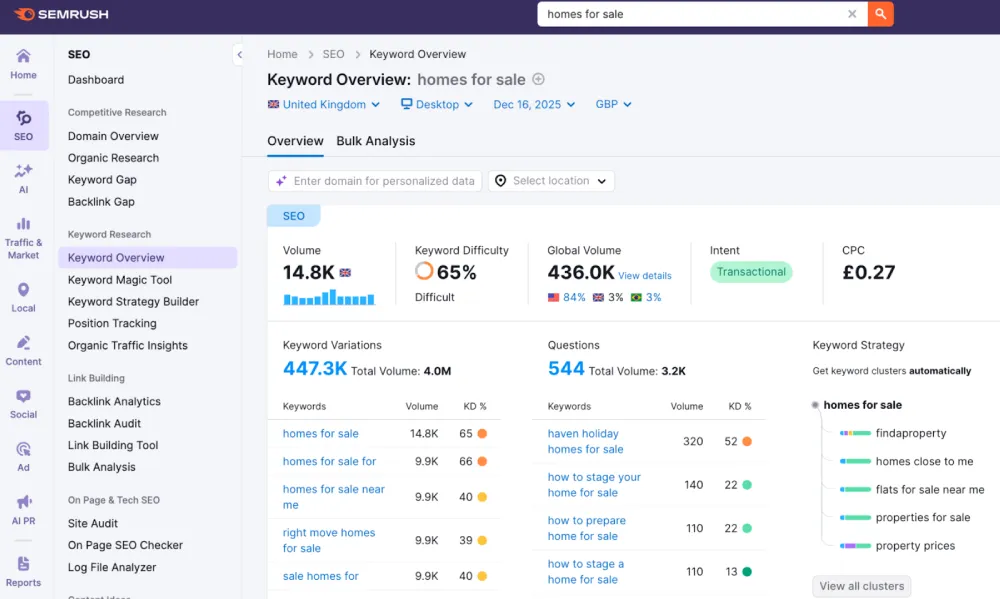
Source: Semrush
What matters most isn’t how many reviews you have.
It’s how often you get them.
Review velocity consistently outperforms review volume.
Simple actions make a big difference:
- Ask for reviews immediately after a successful deal
- Post updates, photos, and recent sales every week
- Fully optimise services, categories, and local keywords
An active profile signals trust and relevance to Google.
Inactive profiles sink, even if the business is legitimate. This is why active Google Business Profiles often outrank paid property ads for local searches.
They’re fresher, more trusted, and more useful.
For agents looking for the best way to get real estate clients organically, this is one of the highest-ROI places to focus.
Related Read: Estate Agent SEO 2026: How Top UK Agencies Get 50–300+ Free Google Leads Every Month
7. Generate Referrals Through Strategic Local Partnerships
Your next real estate client is usually already speaking to another professional.
Mortgage brokers, contractors, designers, solicitors, and estate planners talk to buyers and sellers every day.
Often, weeks or months before someone contacts an agent. Most agents approach partnerships the wrong way. They ask for referrals and move on. That rarely works.
The agents who get consistent referral leads focus on value first. They look for ways to support their partners, not just exchange names.

Source: Freepik
This can be simple:
- Featuring a partner in a short newsletter
- Sharing local market insights they can pass to clients
- Co-hosting small workshops or local Q&A sessions
These actions build trust on both sides. Over time, you become the agent they recommend without being asked.
This creates warm, high-quality real estate leads that convert far better than cold traffic or property ads. And the more locally focused you are, the easier these partnerships become.
8. Become the Go-To Agent in One Neighbourhood
Trying to cover every area usually weakens your position.
Focusing on one neighbourhood builds authority faster and reduces competition.
People trust the agent who clearly owns a specific area. This isn’t about doing more. It’s about being more relevant.
Agents who win locally focus on:
- Pricing and sales trends in one area
- School zones, amenities, and lifestyle insights
- Clear, simple updates about what’s changing nearby
Community presence matters too. Local events, sponsorships, and visibility reinforce your name beyond social media.
Consistency is the difference. Showing up once won’t move the needle. Repeating the same message over time will.
As authority grows, sellers seek you out and buyers follow. That’s how agents create steady enquiries without relying on real estate advertising.
Also Read: The Role of Storytelling in Real Estate Lead Generation and Client Retention
9. Use Testimonials and Case Studies to Shorten Sales Cycles
Buyers and sellers trust other buyers and sellers more than they trust agents.
That’s why social proof shortens sales cycles so effectively. It removes doubt before it turns into hesitation.

Source: Freepik
The best time to ask for a testimonial is immediately after closing, when emotions are high and the experience is fresh.
Waiting weeks usually means it never happens.
Both formats work, but they serve different roles.
Text testimonials are quick to read and easy to place across your website.
Video testimonials build stronger trust and work especially well for listings and presentations.
Where you place proof matters as much as collecting it.
Use testimonials at decision points:
- Landing pages
- Valuation pages
- Listing presentations
- Follow-up emails
When proof shows up at the right moment, prospects move faster and ask fewer questions. That’s how you close more deals without pushing harder or spending more on paid ads.
10. Track the Activities That Actually Lead to Closings
If you want to increase real estate sales without more ads, you need to track the right numbers.
Most agents look at vanity metrics. Views. Clicks. Impressions. They feel good, but they don’t close deals.

Source: Freepik
The numbers that matter tell you exactly where leads are leaking. Start with your website conversion rate.
Most real estate websites convert at 2–3%. Well-optimised sites reach 8–12%. That’s the difference between wasting traffic and turning it into enquiries.
Next is the lead-to-appointment rate.
If fewer than 30–40% of your real estate leads become appointments, your response speed or messaging needs work.
Then look at the appointment show-up rate.
Industry average sits around 50–60%. With reminders and clear pre-framing, 80%+ is achievable.
Finally, track offer-to-close rate.
This shows how well your sales process converts warm prospects into completed deals.
Each metric points to a specific fix:
- Low conversions mean weak trust or unclear CTAs
- Low appointments mean slow or inconsistent follow-up
- Low show-up rates mean poor expectation-setting
- Low close rates mean qualification or presentation gaps
Once you understand where deals are slipping, growth becomes predictable.
Also Read: Top 10 AI Tools Every Business Needs to Win in 2026 (Tested on Real Companies)
Marketing Research & Strategy
We help you understand your market and build smart strategies to attract more customers and grow faster.
- Detailed research into your competitors, customers, and market
- Custom marketing and growth plans that drive real results
- Clear action steps to increase traffic, leads, and sales
ADWORDS ROI
Cut Ad spend
More Sales Don’t Always Require More Ad Spend
Increasing real estate sales doesn’t require more ads. It requires better systems.
When you improve speed, trust, follow-up, and focus, the same leads start producing more appointments and more closings.
If you want a clear, personalised plan for your business, book a free 1:1 call with our marketing experts.
We’ve helped real estate agents increase revenue within months by fixing funnels and lead follow-up—not by spending more on ads.
Book your call today and get strategies you can start using immediately.
FAQs
How can I increase real estate sales organically?
Focus on systems, not traffic. Use local SEO, an active Google Business Profile, educational content, fast follow-up, and consistent nurturing. These attract higher-intent real estate leads and convert more clients without paid ads.
Why do real estate ads get clicks but no enquiries?
Because the issue is usually after the click. Slow response times, weak trust signals, unclear CTAs, and poor follow-up stop leads from converting. Ads generate interest; your funnel determines results.
What should I fix first when leads don’t convert?
Start with response speed and follow-up. Instant replies and structured follow-up often produce the fastest gains. After that, improve landing page trust and clarity.
How do I stop real estate leads from ghosting?
Respond faster, follow up consistently, and add value in every touch. Most leads go quiet due to timing, not lack of interest. Automated, value-based follow-up keeps you relevant until they’re ready.
What type of content attracts high-intent buyers and sellers?
Educational content. Market updates, pricing insights, buyer and seller mistakes, and neighbourhood trends attract serious prospects. Teaching builds trust faster than promotional posts or property ads.
What’s the best way to get more real estate clients without ads?
Activate referrals, dominate one local area, use short-form educational video, and optimise Google Business Profile. These channels consistently outperform paid ads when systems are in place.


