
How Long Does It Really Take to Get Real Estate Leads From SEO?


Why Real Estate Leads from SEO Takes Long Time?
Table of Contents
Serious about growing your business? Let’s plan exactly how to get you more leads, sales, and results—faster.
If you run a real estate business, you’ve probably already heard that SEO works.
That’s not the real concern.
The real concern is when it actually starts bringing enquiries, calls, form fills, serious buyers or sellers, not just impressions and traffic graphs.
SEO for real estate isn’t about visibility for the sake of it. It’s a lead channel. And like any lead channel, it follows a pattern. You don’t switch it on and suddenly get clients. It builds, settles, and then compounds.
This matters because a lot of real estate companies invest in SEO with the wrong expectations.
They compare it to ads, portals, or referrals, and then assume it’s “not working” when leads don’t appear immediately.
This article will tell you exactly what really happens with search engine optimisation for real estate, how long it takes to get you new clients, what you’ll see along the way, and how to judge whether SEO is worth investing in for your agency, brokerage, or property business.
The Short Answer (So You Don’t Waste Time)
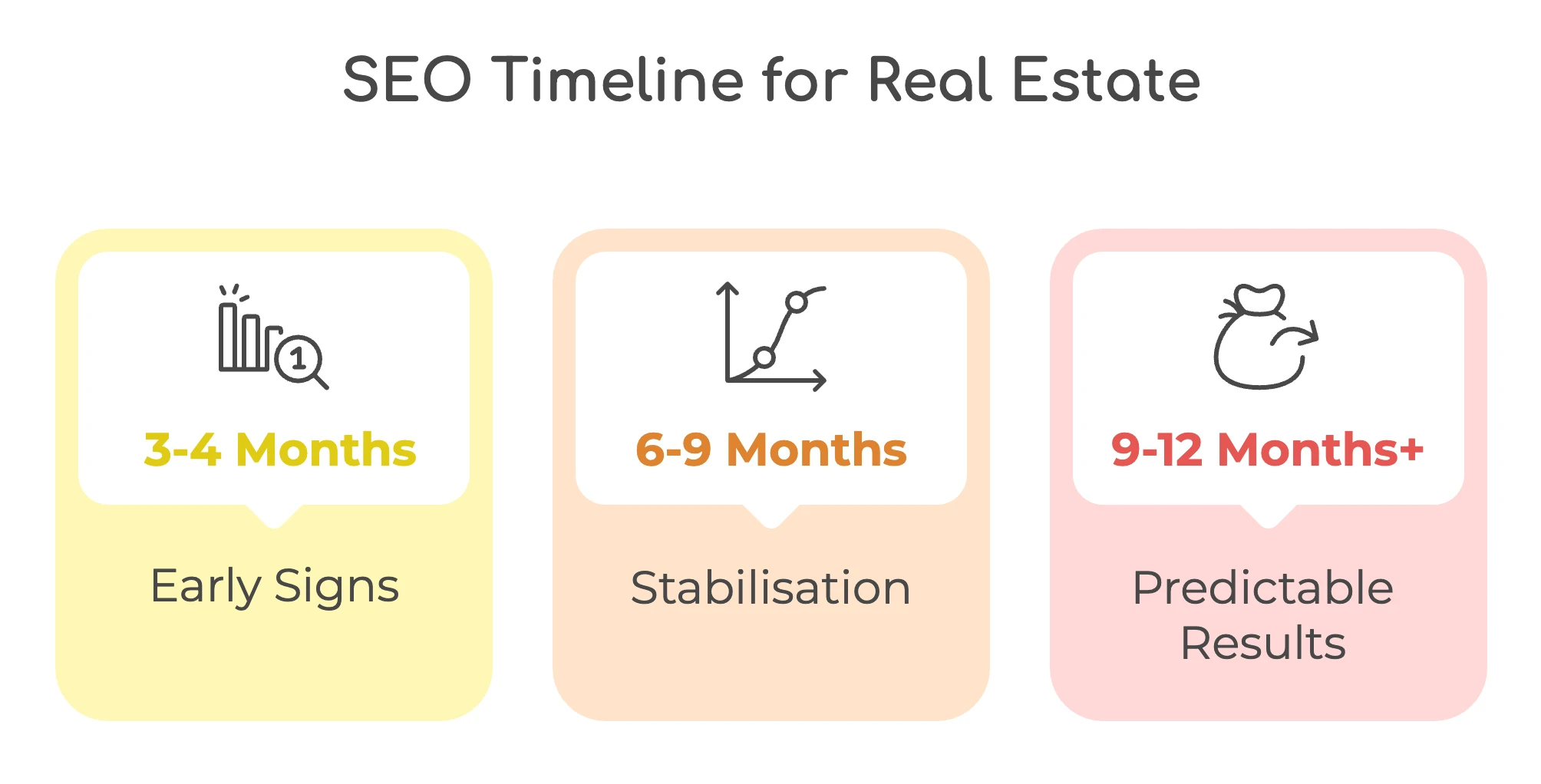
For most real estate businesses, SEO follows a fairly consistent timeline.
In the first 3–4 months, you’ll usually see early signs of movement.
Pages start getting indexed properly, long-tail keywords begin to rank, brand searches increase, and you might get the odd enquiry. This is the phase where SEO for real estate sites starts to show life, but it’s not yet reliable.
Between 6 and 9 months, things change.
Rankings stabilise, local visibility improves, and enquiries become more consistent, especially for estate agents and realtors operating in local or mid-competition markets.
This is typically when businesses first feel that SEO for real estate agents is actually working as a lead channel.
By 9 to 12 months and beyond, SEO becomes predictable.
At this stage, real estate website SEO starts generating leads week after week, not randomly. This is where SEO for real estate pays off as a scalable, lower-cost acquisition channel compared to ads or portals.
This isn’t guesswork. HubSpot’s inbound data has shown for years that SEO and content-led channels compound over time, with the strongest returns appearing after the six-month mark, not in the early weeks.
So if someone promises “SEO leads in 30 days,” they’re almost certainly running ads under the hood, or ranking you for keywords that look good in reports but don’t bring real clients.
You Might Also Like Reading: Estate Agent SEO 2026: How Top UK Agencies Get 50–300+ Free Google Leads Every Month

Why SEO Takes Time in Real Estate (Specifically)
Real estate is one of the slower industries when it comes to SEO. That’s not a flaw in SEO — it’s the nature of the market.
Property is a high-trust, high-value decision, and people aren’t clicking impulsively — they’re researching, comparing, and evaluating options.
In fact, over 97% of homebuyers begin their property search online, meaning the research phase is deep and extended, not transactional.
That’s why real estate falls under what Google classifies as “Your Money or Your Life” (YMYL) topics.
Pages that can significantly impact someone’s financial decisions are held to a higher standard of trust and authority before they’re allowed to rank consistently.
On top of that, most real estate businesses are competing in crowded local markets.
You’re up against large portals and aggregators that have been building authority for years, national brands, and local competitors with entrenched visibility in organic results.
SEO isn’t just about placing keywords on a page. It’s about earning trust from both users and search engines over time.
Meaningful SEO gains — especially in competitive sectors like real estate — typically take consistent work over an extended timeline, often 6–12 months or more before stable visibility and traffic results emerge.
Until credibility signals such as domain authority, high-quality content, backlinks, and positive user behaviour stack up, rankings tend to move slowly and cautiously.
That’s why progress in real estate SEO often feels gradual at first, even when the work is being done correctly.
What Actually Determines Your SEO Timeline
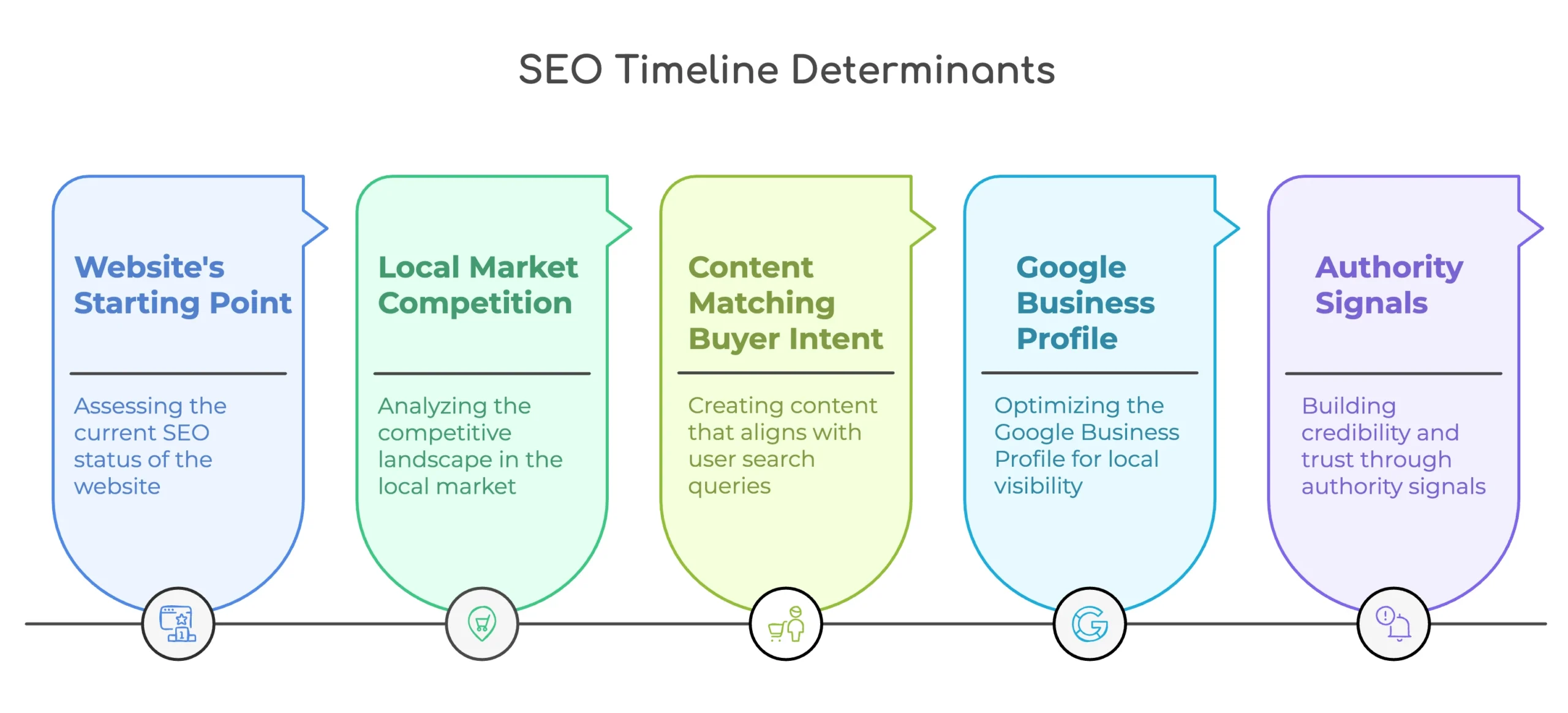
Your Website’s Starting Point
Where your website is today matters more than most people realise.
New domains almost always move more slowly. In multiple SEO studies, websites under 6 months old consistently take longer to achieve stable rankings, largely because Google has limited historical data on trust, engagement, and reliability.
By contrast, older sites tend to see traction sooner simply because they already have crawl history, backlinks, and behavioural signals.
Industry benchmarks regularly show that most sites begin seeing meaningful SEO movement between months 3–6, while consistent rankings and lead flow often take 6–12 months, especially in competitive sectors like real estate.
If a site also has thin content, technical issues, or years of neglect, SEO has to undo damage before it can build momentum. That clean-up phase alone can add months to the timeline.
SEO for real estate sites doesn’t start from zero. It builds on whatever foundation already exists — good or bad.
Marketing Research & Strategy
We help you understand your market and build smart strategies to attract more customers and grow faster.
- Detailed research into your competitors, customers, and market
- Custom marketing and growth plans that drive real results
- Clear action steps to increase traffic, leads, and sales

ADWORDS ROI

Cut Ad spend

Your Local Market Competition
Your location plays a huge role in how fast SEO works.
In smaller towns, SEO often moves faster simply because there are fewer competitors competing for the same searches.
Fewer strong pages, fewer authoritative backlinks, and less aggressive optimisation overall mean Google has fewer “trusted” options to choose from.
In larger cities, the landscape is very different. You’re competing with:
- Established agencies
- National property portals
- Businesses with years of local authority

Data across SEO case studies shows that competitive local keywords can take 2–3× longer to break into page one compared to low-competition or long-tail searches.
In these markets, SEO for real estate agents takes longer because you’re not just trying to rank — you’re trying to displace businesses that already have authority.
The market doesn’t make SEO impossible. It just stretches the timeline.
Must Read: 10 Google SEO Guidelines for 2025–2026: Master E-E-A-T & Core Updates to Rank Higher
Content That Matches Buyer Intent
Publishing content alone doesn’t move rankings. Publishing the right content does.
Search behaviour data consistently shows that the majority of organic traffic (often ~70%) comes from long-tail, intent-driven searches, not broad informational keywords. In real estate, that means location-specific pages, buyer and seller questions, and investment-focused searches, not generic advice posts.
Google’s own ranking systems prioritise pages that best satisfy search intent, which is why intent-aligned pages tend to rank faster and convert better.
In service-based industries, intent-matched pages routinely outperform high-traffic informational content in enquiry rates.
This is where many real estate websites go wrong. They publish safe, broad content and wonder why traffic doesn’t convert.
In practice, one well-written page answering a real buyer question often outperforms ten generic posts, both in rankings and leads.
Digital Marketing, SEO & PPC
- SEO to boost rankings and capture high-intent, AI-driven traffic
- Performance Marketing to run ROI-focused campaigns that convert
- Content Marketing to drive clicks, earn links, and build authority
Google Business Profile (Where Leads Actually Happen)
For real estate, SEO doesn’t live only on your website, a huge share of leads come from local search results, especially the map pack and Google Business Profile (GBP).
Local search behaviors show that Google is where people go first to evaluate nearby businesses: in 2025, 83% of consumers use Google to read reviews about local businesses, and reviews are a major driver of trust and local click-through behaviour.
Studies also show that the Google local 3-pack (map results) captures a significant portion of local clicks, with estimates around 42% of local searchers clicking on map pack results instead of organic links.
When a real estate agent’s GBP is properly set up with accurate info, frequent updates, photos, and reviews, Google is more likely to trust and rank it, and prospects are more likely to call or message directly without ever visiting the website.
If your GBP isn’t fully optimised and supported by reviews and engagement signals, visibility suffers, and leads go to competitors with a stronger local presence.
That’s why many real estate professionals ask, “Can you get clients from SEO?”, when the real issue isn’t the website itself but weak local SEO and GBP optimisation.
Authority Signals That Matter
You don’t need hundreds of backlinks for SEO in real estate to work.
What actually moves rankings are relevant authority signals:
- Local citations
- Industry mentions
- Links from trusted local or regional sources
Across backlink studies, relevance consistently outweighs volume, especially for local SEO. One strong, contextually relevant link can have more impact than dozens of low-quality, unrelated ones.
This matters in real estate because Google is evaluating trust, not just link counts. Local authority, consistency, and credibility carry more weight than raw numbers.
That’s why experienced real estate SEO experts focus less on “how many links” and more on where authority is coming from.
Also Read: How to Increase Real Estate Sales Without Spending More on Ads

What SEO Results Actually Look Like
SEO doesn’t switch on. It builds gradually.
For most real estate sites, the early signs are subtle and easy to miss if you’re only watching leads.
Typically, the pattern looks like this:
- Search impressions increase before clicks
- Long-tail and location-specific keywords start ranking first
- Branded searches rise as your name appears more often
- Enquiries come in sporadically at first
- Over time, those enquiries become consistent
This mirrors what Google Search Console data shows across thousands of service-based websites. Visibility always comes before volume.
So if leads appear overnight, they’re almost certainly coming from another channel — not SEO.
Should You Invest in SEO or Not?
SEO for real estate makes sense if:
- You want a lead source that becomes cheaper over time
- You’re tired of depending entirely on portals or paid ads
- You plan to be in business beyond the next six months
SEO doesn’t make sense if:
- You need leads immediately
- You’re only willing to commit for a few months
- You expect guaranteed lead numbers
SEO rewards consistency, not urgency.
Recommended Read: Slow Lead Responses: Why You’re Losing 78% of Sales in 2025–2026 (And How to Fix It)
How Smart Real Estate Businesses Get Results Faster
The businesses that see SEO work sooner aren’t chasing shortcuts. They’re removing friction.
Instead of trying to do everything at once, they focus on a few things that actually move the needle:
- Buyer-intent pages before generic content
- Local visibility before broad or national reach
- Depth and clarity instead of publishing volume
- Clear conversion paths so traffic knows what to do
Most delays in SEO for real estate companies don’t come from Google.
They come from sa cattered strategy, too many pages, unclear messaging, and no real priority on what should rank first.
Marketing Research & Strategy
We help you understand your market and build smart strategies to attract more customers and grow faster.
- Detailed research into your competitors, customers, and market
- Custom marketing and growth plans that drive real results
- Clear action steps to increase traffic, leads, and sales
ADWORDS ROI
Cut Ad spend
SEO vs Ads: The Practical Reality
Ads are fast and controllable.
SEO is slower, but it compounds.
Paid traffic gives you speed. SEO for real estate gives you stability.
Industry ROI data consistently shows that businesses using both perform better long term — ads to create momentum, search engine optimisation for real estate to reduce dependency over time.
The mistake isn’t choosing SEO or ads.
It’s trying to run one in isolation instead of sequencing them properly.
The Truth Most SEO Blogs Don’t Say
SEO doesn’t generate leads on its own. Positioning does.
SEO simply puts your real estate business in front of people who are already searching. What happens next depends on whether your site builds trust, shows expertise, and makes it easy to take the next step.
That’s why some real estate sites rank on page one and still struggle for enquiries. Visibility without clarity doesn’t convert, no matter how good the SEO looks on paper.
Digital Marketing, SEO & PPC
- SEO to boost rankings and capture high-intent, AI-driven traffic
- Performance Marketing to run ROI-focused campaigns that convert
- Content Marketing to drive clicks, earn links, and build authority
Want SEO to Actually Work for Your Business?
SEO for real estate should generate enquiries, not just traffic. That means focusing on search intent, local visibility, and conversions, not generic checklists.
Our team has helped estate agents, realtors, and property businesses turn search traffic into real leads. Book a 1:1 strategy call to see whether SEO makes sense for your market and goals.
Frequently Asked Questions related to SEO
Can SEO really replace paid ads for real estate leads?
SEO can reduce your reliance on paid ads over time, but it rarely replaces them overnight.
Ads provide speed, while SEO compounds and lowers cost per lead long term.
The strongest real estate businesses use ads for short-term momentum and SEO for sustainable lead generation.
Why am I getting traffic but no real estate enquiries from SEO?
This usually happens when content targets broad or informational keywords instead of buyer or seller intent. Rankings alone don’t generate leads.
Pages must align with local searches, decision-stage intent, and clear conversion paths to turn traffic into enquiries.
Is SEO still worth it for real estate businesses in 2026?
SEO is still one of the highest-ROI channels for real estate in 2026, but only when it’s intent-driven and local-first.
Businesses relying on generic blogs or outdated tactics struggle, while those focused on buyer intent, local visibility, and conversion continue to see consistent, compounding leads.


