
SEO for Small Businesses in the UK: What to Do in 2026


SEO for Small Businesses in the UK
Table of Contents
Serious about growing your business? Let’s plan exactly how to get you more leads, sales, and results—faster.
Every day, your potential customers are searching and choosing someone else.
Search is still the starting point for most buying decisions in the UK. Around 82% of UK adults use Google Search, and it processes billions of searches every month.
But the way people interact with results is shifting. AI Overviews now appear in roughly 30% of searches, often answering questions before users even click.
So it’s not just about being on Google anymore. It’s about being the result people notice, trust, and choose.
At the same time, competition is built in.
The UK has 5.6 million small businesses, making up 99.2% of the business population. In practical terms, that means almost every search you care about already has multiple businesses fighting for attention.
What this really comes down to is visibility.
If you’re not showing up in the right places, for the right searches, at the right time, you’re losing business to competitors who are.
This guide breaks down exactly what UK small businesses should focus on in 2026, from technical SEO and local visibility to content strategy, costs, and how to stay visible as AI reshapes search.
Why SEO still matters for UK small businesses
Short answer: yes, SEO still works, and yes, it’s still worth it.
Longer answer: it works because the behaviour hasn’t changed. People still go to Google first when they need something. Whether it’s a plumber, a solicitor, or a local café, the journey usually starts with a search.
And Google still dominates that moment. It holds over 91% of the UK search market, which means most of your potential customers are looking in one place.
Now add competition. As mentioned earlier, the UK has millions of small businesses, all trying to get in front of the same audience. That makes visibility the real bottleneck. Not demand.
Here’s the part a lot of businesses miss: SEO isn’t just about rankings, it’s about building a channel that compounds.
- Paid ads stop the second you stop spending
- Social reach comes and goes
- SEO builds over time and keeps working
A well-optimised page can bring in leads for months or years without ongoing spend. That’s what makes it different.
So is SEO important? Yes, because your customers are searching.
Does SEO work? Yes, if it’s done properly and consistently.
Is it worth it? For most small businesses, it’s one of the few channels that becomes more valuable the longer you invest in it.
What Search Engine Optimisation for Small Business Means
Search engine optimisation for small businesses means improving your website so search engines can understand it and potential customers can find it.
In simple terms, SEO helps your business appear when people search for your services, products, or expertise. It is not just about keywords. It is about making your website clear, useful, relevant, and easy to trust.
For small businesses, good SEO should help in three ways:
- make your pages easy for Google to crawl and understand
- match your content to what people are actually searching for
- bring in visitors who are more likely to enquire, call, or buy
SEO is not about trying to trick search engines.
It is about creating helpful, people-first content and building a website that gives clear answers and a good user experience.
Digital Marketing, SEO & PPC
- SEO to boost rankings and capture high-intent, AI-driven traffic
- Performance Marketing to run ROI-focused campaigns that convert
- Content Marketing to drive clicks, earn links, and build authority
How Google and AI Search Decide Which Businesses to Show
Google decides what to show in search through three main steps: crawling, indexing, and ranking.
- Crawling is when Google finds pages on the web.
- Indexing is when it tries to understand what those pages are about.
- Ranking is when it decides which pages are most relevant and useful for a search.
For small businesses, this means your website needs to be easy to find, easy to understand, and genuinely helpful. If your pages are unclear, thin, or poorly structured, they are less likely to perform well.
AI search works in a similar way. Features like AI-generated answers still depend on useful web content. They do not replace SEO fundamentals. They build on them.
So if you want stronger visibility in both Google search and AI-powered results, the focus is still the same: create clear pages, answer real questions, and make your website easy for search engines to understand.
In simple terms
Google finds pages, understands pages, then chooses which ones to show. AI search still relies on that same foundation.
What Small Businesses Need to Rank in Google in 2026
To rank well in 2026, small businesses need more than just keywords. Google is looking for websites that are useful, clear, trustworthy, and easy to understand.
That means SEO is no longer one single task. It is a mix of different areas working together.
For most small businesses, the main parts of SEO to focus on are:
- technical SEO to make sure your website works properly
- on-page SEO to make each page clear and relevant
- local SEO to appear in nearby searches and Google Maps
- content SEO to answer real questions and target the right searches
- off-page SEO to build trust through links, mentions, and reviews
- AI search readiness to make your content easier to understand and cite
The good news is that you do not need to do everything at once. Most small businesses get the best results by fixing the basics first, then improving each area step by step.
In the next sections, we’ll look at each part in a simple, practical way.

Why Technical SEO Matters Before Anything Else
As mentioned earlier, technical SEO is the part of SEO that makes sure your website works properly.
Think of it like this: if your website is slow, messy on mobile, or hard for Google to read, it becomes much harder to rank well — even if your content is good.
For most small businesses, technical SEO is not about complicated coding. It is about making sure your site:
- loads quickly
- works well on mobile
- is secure
- has no broken pages or links
- is easy for Google to access
If these basics are in place, the rest of your SEO has a much better chance of working.
One important part of technical SEO is page experience.
In simple terms:
- LCP checks how quickly the main part of a page loads
- INP checks how quickly the page responds when someone clicks
- CLS checks whether things jump around while the page is loading
You do not need to remember those terms in detail.
What matters is this: your website should feel fast, smooth, and stable for visitors.
What to fix first
- mobile issues
- slow pages
- broken links
- redirect problems
A simple way to think about technical SEO is this: it removes problems that stop your website from performing properly.

How to Optimise Each Page for the Right Search with On-Page
On-page SEO is about making each page clear for both Google and your visitors.
It includes your page title, main heading, subheadings, page copy, internal links, image alt text, and page structure.
Google advises using the words people search for in important places like the title, heading, alt text, and link text.
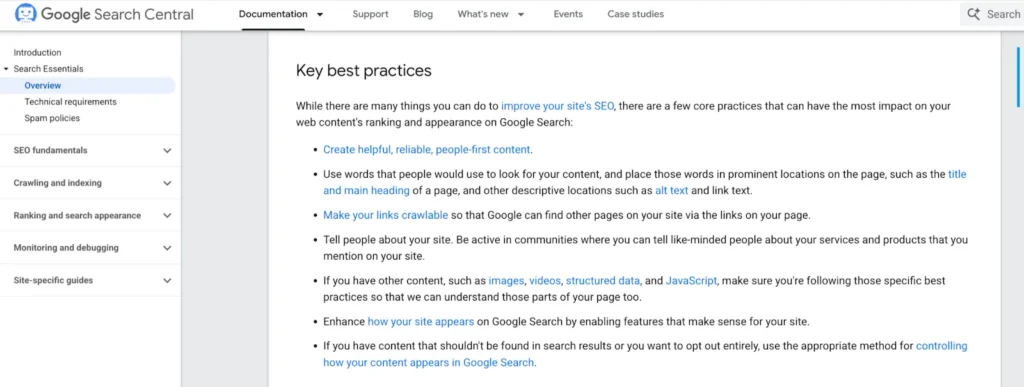
Source: Google Search Central
The key is to keep each page focused on one clear topic or service. If a page tries to cover too much, it usually becomes weaker.
It also needs to match search intent. A service search should lead to a service page. A question should lead to a helpful guide or FAQ.
Structured data can also help Google understand your page better and may make it eligible for rich results, though that is not guaranteed.
What on-page SEO includes
- page titles
- headings
- useful content
- internal links
- image alt text
- clear structure
In simple terms
On-page SEO helps each page explain itself clearly and target the right search.
How Local SEO Helps Small Businesses Get More Enquiries
For many small businesses, local SEO is where SEO becomes most visible and most valuable. If you serve a town, city, or specific area, local SEO helps you appear when nearby customers search for what you offer.
Google says local results are mainly based on relevance, distance, and prominence.
In simple terms, Google wants to show a business that matches the search, is close enough to the user, and looks trustworthy.
Google also makes it clear that there is no way to pay for a better local ranking.
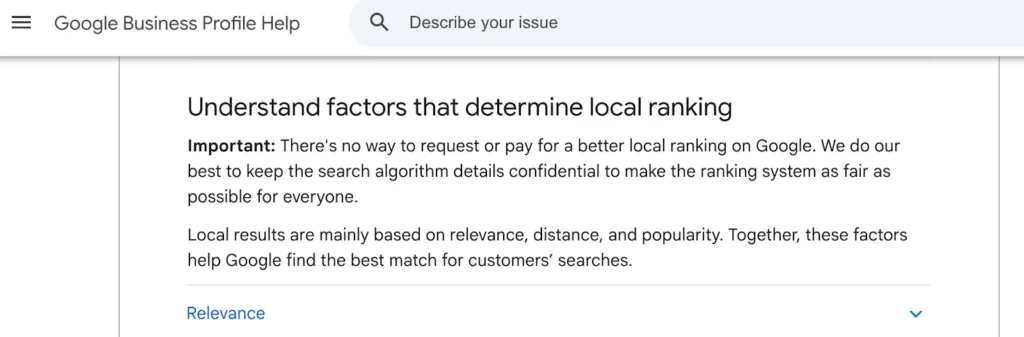
Source: Support Google
That is why local SEO is not just about being listed. It is about giving Google and potential customers the right signals.
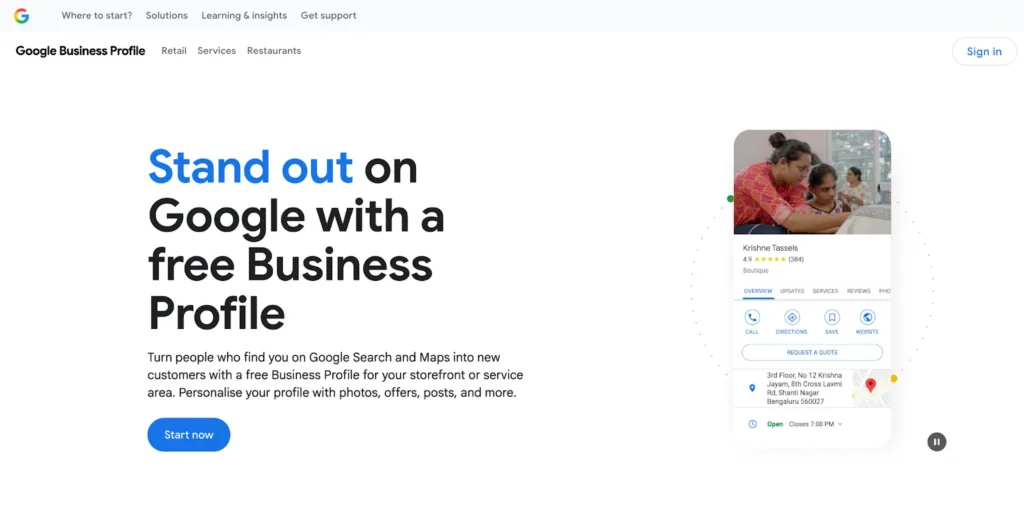
One of the most important is your Google Business Profile, which helps your business appear on Google Search and Maps.
Reviews matter here, too, because local SEO is closely tied to trust. BrightLocal reports that 97% of consumers read reviews for local businesses, and 68% say they would not use a business with fewer than four stars.
For small businesses, good local SEO usually means:
- a fully set up Google Business Profile
- accurate business details across the web
- strong local service or location pages
- consistent reviews and review replies
- clear proof that you serve the area
In simple terms, local SEO helps you show up where nearby customers are already looking — and gives them more reasons to trust you when they find you.
What Content Small Businesses Should Create First
A lot of small businesses start SEO with blog posts. In most cases, that is not the best place to begin.
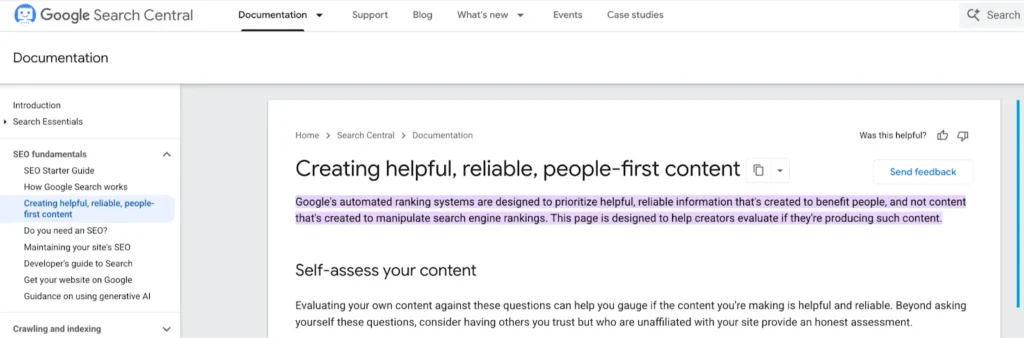
Google’s guidance is clear: content should be helpful, reliable, and people-first. It should be created to genuinely help users, not just to attract search traffic. Google also says AI can be useful for research and structure, but publishing lots of pages without adding real value can fall into spam territory.
Source: Google Search Central
That is why content should be prioritised in the right order.
What to create first
- service pages that clearly explain what you offer
- location pages if you serve specific towns, cities, or areas
- trust pages such as about, case studies, reviews, and contact pages
- high-intent blog content that answers buyer questions
- FAQs that deal with objections, pricing, process, and timelines
For most small businesses, service pages should come first because they target the searches most likely to lead to enquiries. Blog content should support those pages, not replace them.
A simple way to think about it is this: create the pages people need when they are ready to choose, then create the content that helps them get there. That approach is usually stronger than publishing lots of generic articles with little original value.
In simple terms
Start with the pages that can win business, then build supporting content around them.
How Off-Page SEO Builds Trust and Authority
Off-page SEO is about the signals outside your website that help build trust in your business.
The best-known example is backlinks — links from other websites to yours.
But good off-page SEO is not about getting as many links as possible. It is about earning the right kind of signals from the right places.
For small businesses, that usually means:
- relevant backlinks from trusted websites
- local citations and directory mentions
- reviews on important platforms
- brand mentions on other websites
- links from partners, suppliers, or associations
- digital PR and local press coverage
What matters most is relevance and quality. A link from a trusted local publication or industry website is far more useful than lots of random low-quality links.
This is also why shortcuts can do more harm than good. If links or mentions look manipulative or unnatural, they can weaken trust instead of building it.
In simple terms, off-page SEO helps show that your business is credible beyond your own website. It tells Google that other people, businesses, and websites recognise you as real, relevant, and worth noticing.
In simple terms
On-page SEO helps you explain yourself.
Off-page SEO helps other websites back that up.
How to Stay Visible in AI Overviews and LLM Search
Search is changing, but the goal is still the same: be the source that gets noticed, trusted, and used.
And Google says AI Overviews give people a quick snapshot with links to dig deeper.
It also says these results can show links in different ways and surface a wider range of sources. That means AI visibility is still tied to web content. It is ₹not separate from SEO.
The same idea applies beyond Google too.
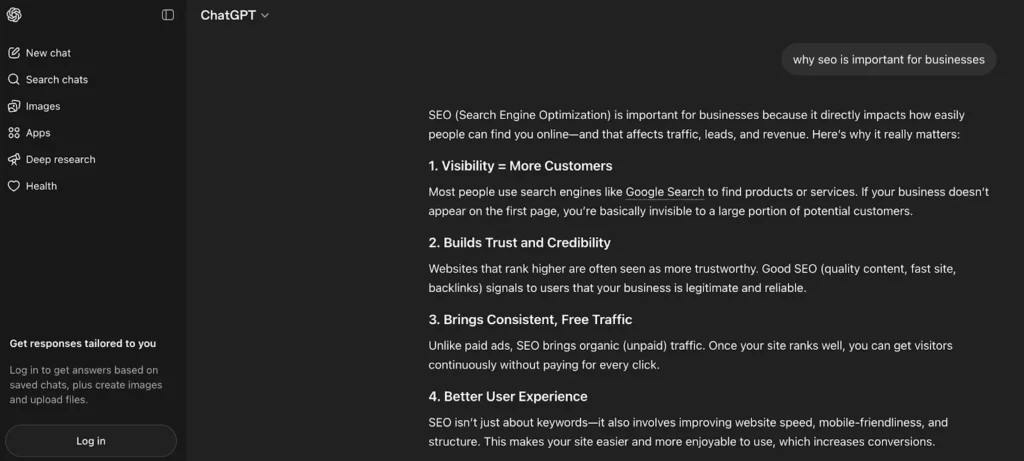
Tools like ChatGPT, Claude, and Perplexity can now search the web and provide answers with links or citations.
Source: ChatGPT
Source: Gemini
Source: Perplexity
Ofcom says 32% of UK online adults visited at least one major AI chatbot in June 2025, including ChatGPT, Perplexity, Claude, Gemini, Copilot, DeepSeek, and Grok.
So if you want better visibility in AI-driven search, your pages need to be:
- easy to scan
- clear in structure
- specific in what they answer
- backed by trustworthy facts
- strong enough to quote or cite
In simple terms, AI-friendly content usually looks a lot like good SEO content.
It answers real questions clearly, avoids fluff, uses strong headings, and gives useful detail without becoming hard to follow. Google’s own advice for succeeding in AI search is still rooted in creating satisfying content for people.
In simple terms
If your content is clear, useful, and easy to trust, it has a better chance of showing up in both Google search and AI-powered answers.
How Much SEO Costs for a Small Business in the UK
There is no single fixed price for SEO, because not every small business needs the same level of work.
The cost usually depends on things like:
- how competitive your market is
- whether you need local or national SEO
- how strong your website is right now
- how much content needs improving or creating
- whether technical issues need fixing
- how much ongoing support you want
So instead of asking, “What is the average cost?”, it is usually better to ask, “What am I actually paying for?”
As a general guide, small business SEO in the UK often starts around £300–£750 per month for light local support, while more meaningful ongoing work commonly sits around £750–£2,000 per month.
More competitive campaigns can go well beyond that.
These figures are based on recent UK agency pricing guides, so they should be treated as market ranges rather than official benchmarks.
That matters because Google Search is still where most demand begins. Ofcom says 82% of UK adults use Google Search, and it handles 3 billion searches a month in the UK.
Google says a good SEO professional may help with things like reviewing your site structure and content, giving technical advice, developing content, managing campaigns, doing keyword research, offering training, and bringing expertise in specific markets or locations.
That means a proper SEO service should usually include:
- research and planning
- technical improvements
- on-page optimisation
- content support
- local SEO works if relevant
- reporting and strategy guidance
This is also why very cheap SEO can be risky. If the service is vague, focused only on rankings, or built around shortcuts, it may not include the work that actually improves visibility.
Google also warns against manipulative tactics and unrealistic promises.

Should You Hire an SEO Agency, Consultant, or Do It Yourself?
This depends on your goals, budget, and how much time you can realistically give to SEO.
If you run a small local business with a simple website, you can often handle some of the basics yourself.
Google says that many small local businesses can do much of the work on their own, especially when it comes to improving pages, learning the basics, and following trusted guidance.
But once SEO starts involving technical issues, content planning, local competition, or ongoing strategy, outside help can save time and prevent mistakes.
Google also says hiring an SEO can improve your site and save time, but an irresponsible SEO can damage your site and reputation.
Doing it yourself
This can work well if:
- you have one location or a small service area
- your website is simple
- you are happy to learn the basics
- you have time to keep improving pages consistently
DIY SEO is often best for getting the foundations in place.
Hiring a consultant
A consultant is usually a good fit if:
- you want expert advice without a full agency retainer
- you need strategy, audits, or direction
- you already have someone who can implement changes
- your business needs a more focused or flexible setup
This can be a strong option for businesses that want guidance but do not need a full team.
Hiring an agency
An agency is often the better fit if:
- you need help across technical SEO, content, local SEO, and reporting
- you want ongoing execution, not just advice
- your market is competitive
- you do not have time to manage everything internally
A good UK SEO agency should offer more than rankings talk. Google says a strong SEO provider may help with site reviews, technical advice, content development, keyword research, training, campaign support, and expertise in your market or location. (developers.google.com)
What to look for in any provider
- clear deliverables
- realistic expectations
- examples of past work
- transparency about what they will change
- understanding of your market and location
- no guaranteed rankings
If anyone promises instant results, guaranteed positions, or vague “secret methods”, that is usually a red flag.
In simple terms
Do it yourself if your needs are simple and you have time.
Hire a consultant if you need strategy.
Hire an agency if you need strategy and execution together.
Marketing Research & Strategy
We help you understand your market and build smart strategies to attract more customers and grow faster.
- Detailed research into your competitors, customers, and market
- Custom marketing and growth plans that drive real results
- Clear action steps to increase traffic, leads, and sales

ADWORDS ROI

Cut Ad spend

A Simple 90-Day SEO Plan for Small Businesses
If you are not sure where to start, the easiest approach is to work in the right order. Do not jump straight into blog writing or backlinks if the basics are not in place first.
Fix the foundations
Start by making sure your website can be properly found, crawled, and trusted.
Focus on:
- checking that important pages are indexed
- fixing broken links and obvious errors
- improving mobile usability
- making key pages load properly
- setting up or improving your Google Business Profile
- making sure your contact details are consistent
This stage is about removing problems that hold everything else back.
Improve your key pages
Once the foundations are in place, focus on the pages most likely to bring in enquiries.
Work on:
- your main service pages
- your most important location pages
- page titles and headings
- internal links between related pages
- clearer calls to action
- trust signals like reviews, testimonials, and proof of experience
This stage is about making your website more relevant and more convincing.
Build content and strengthen visibility
Now you can start expanding.
Focus on:
- answering common customer questions
- creating useful blog or FAQ content
- improving local signals and reviews
- building trusted mentions or backlinks
- tracking which pages are getting clicks and enquiries
This stage is about growing your reach without losing focus.
Build content and strengthen visibility
Now you can start expanding.
Focus on:
- answering common customer questions
- creating useful blog or FAQ content
- improving local signals and reviews
- building trusted mentions or backlinks
- tracking which pages are getting clicks and enquiries
This stage is about growing your reach without losing focus.
In simple terms
First, fix what is broken.
Then improve your most important pages.
Then build out content and authority step by step.
Digital Marketing, SEO & PPC
- SEO to boost rankings and capture high-intent, AI-driven traffic
- Performance Marketing to run ROI-focused campaigns that convert
- Content Marketing to drive clicks, earn links, and build authority
Want More Free Leads from SEO? Book a Free 1:1 Strategy Call
If you want to know what your business should actually do next, book a free 1:1 SEO strategy call.
Our team of SEO experts will look at where your website stands now, what may be holding it back, and which SEO actions could help you get more visibility, more enquiries, and more free leads over time.
On the call, you can get clarity on:
- what to fix first
- which pages need improving
- how local SEO can help
- what content to create
- whether SEO is the right investment for your business
Frequently Asked Questions
Does SEO work for small businesses?
Yes, SEO can work very well for small businesses when it is done properly. Small businesses do not need to outrank every big brand. They need to appear for the right searches, especially local and service-based ones. A well-optimised website can bring in relevant traffic, calls, and enquiries consistently.
Is SEO worth it for small businesses?
In many cases, yes. Unlike paid ads, SEO can keep bringing in traffic and leads long after a page is published and improved. It usually takes time, but it can become one of the most cost-effective channels for long-term growth.
How much does SEO cost for a small business in the UK?
It depends on your market, your website, and how much work is needed. For many UK small businesses, light local SEO support may start from a few hundred pounds per month, while more meaningful ongoing work often sits in a higher monthly range depending on competition and scope. What matters most is not just price, but what is included in the service.
How long does SEO take to work?
SEO usually takes time. Some improvements can show early signs within a few weeks, especially local or technical fixes, but stronger results often build over a few months. The timeline depends on your competition, website quality, and how consistently the work is done.
How do I measure SEO results?
The best way is to track outcomes that matter to your business. That includes:
- enquiries or leads from organic traffic
- calls or form submissions
- rankings for important service keywords
- clicks and impressions in Google Search Console
- visibility in local search and Google Business Profile
Good SEO should not just increase traffic. It should improve qualified traffic.
Can SEO help me get more leads and clients?
Yes. Good SEO helps you appear when people are actively searching for the service you offer. That means the traffic is often more qualified than traffic from channels where people were not looking for you in the first place. If your pages are well optimised and persuasive, SEO can absolutely help generate more leads and clients.
Can ChatGPT do SEO?
ChatGPT can help with parts of SEO, such as research, outlining, content ideas, metadata drafts, FAQs, and improving clarity. But it should not replace strategy, human judgement, or real expertise. SEO still needs proper keyword targeting, technical checks, local optimisation, and content that adds genuine value. AI can support the process, but it should not run the whole thing on its own.